
A couple books you for their wedding eighteen months out. Between that handshake and the last dance there’s a deposit to collect, a package to confirm, add-ons that creep in as the plans firm up — uplighting, a ceremony sound system, an extra hour because the reception’s running long — and a balance that has to be settled before the big day, not chased after it. A wedding is the highest-stakes gig a mobile DJ plays, and the money around it only stays calm if the invoicing is airtight from the deposit to the final balance.
This guide covers a wedding DJ invoice template built for event work: deposit-and-balance billing that holds the date, package pricing the couple can understand, the add-ons that lift your average booking, and how to keep the whole thing clean across the long months between booking and the dance floor.
Why Wedding Billing Needs a Deposit and a Plan
A wedding DJ booking isn’t a transaction — it’s a commitment held open for months. That shapes everything about how you bill:
The deposit holds the date, and the date is irreplaceable. When you accept a wedding, you take that Saturday off the market for every other couple. A deposit — commonly 25%–50% — makes the booking binding and protects you if they cancel. The invoice has to show the deposit collected and the balance that remains.
Packages make the price make sense. Couples compare DJs by package: hours of coverage, ceremony sound, the gear, MC services. Pricing as a named package (“6-hour reception package”) rather than a pile of line items lets the couple understand what they’re buying and compare apples to apples.
Add-ons are where the booking grows. The base package is the starting point. Uplighting, a ceremony sound system, a dance-floor light show, a photo booth, an extra hour — these get added as the planning firms up, often months after the deposit. Each belongs on the invoice as its own line, and the running balance has to stay accurate as they accumulate.
The balance is due before the day, not after. Chasing a balance after the wedding is a nightmare — the couple’s on honeymoon, the moment’s passed, the urgency’s gone. Standard practice is the full balance due a week or two before the event. The invoice states that due date clearly.
It’s a long relationship with one invoice evolving. Eighteen months, a deposit, add-ons, a final balance — it’s one booking that changes over time. The invoice has to be easy to update and always show where things stand.
This doesn’t need event-management software. It needs an invoice that states the package, shows the deposit as a credit and the add-ons as lines, and makes the balance and its due date unmistakable.
What Belongs on a Wedding DJ Invoice
A professional DJ invoice reassures a couple spending big on the most important day of their year. Include:
- Your business name, contact, and any insurance note (venues often require proof)
- The couple’s names and the event date, venue, and times
- Invoice number and date
- The package — hours of coverage and what’s included — clearly named
- Add-ons — uplighting, ceremony sound, extra hours, photo booth — itemized
- Subtotal
- Deposit received shown as a credit
- Balance due and the balance due date (before the event)
- Payment terms and instructions
- Cancellation / rescheduling terms — how the deposit is handled
The cancellation line is non-negotiable for weddings. Stating that the deposit is non-refundable and how rescheduling works protects you against the one thing you can’t recover — a Saturday given away and then cancelled.
Sample Invoice: Wedding Reception Package + Add-Ons
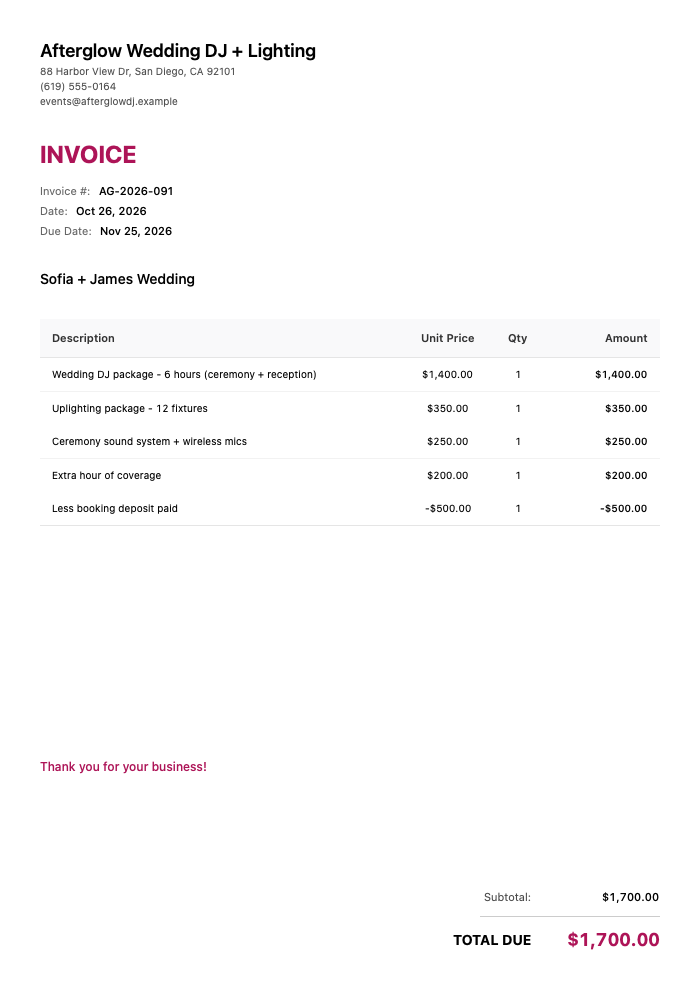
Here’s a wedding DJ invoice for a 6-hour reception package with uplighting, ceremony sound, and a deposit already collected:
Click to view full size
This invoice shows event billing done right:
- The 6-hour reception package named as one line, so the couple sees exactly what the core booking covers
- Uplighting and a ceremony sound system itemized as add-ons, the pieces that grew the booking after the deposit
- The deposit credited against the subtotal, so the couple sees precisely what’s been paid
- A clear $1,700.00 balance due with a due date before the wedding, settling the money before the day arrives
Because the package, the add-ons, and the deposit all show plainly, the couple can see where every dollar went and when the balance is due — no confusion in the final, busiest weeks before the wedding.
Typical Wedding DJ Rates
DJ pricing varies widely by market, experience, package, and season. These are typical US ranges — set yours against your local market, demand, and what’s included.
| Item | Typical Range | Unit |
|---|---|---|
| Wedding reception package (4–6 hr) | $800 – $2,500 | Per event |
| Premium / full-day package | $2,500 – $5,000+ | Per event |
| Deposit to hold date | 25% – 50% | Of total |
| Ceremony sound system | $150 – $500 | Add-on |
| Uplighting | $200 – $600 | Add-on |
| Extra hour of coverage | $150 – $350 | Per hour |
| Photo booth | $400 – $900 | Add-on |
| Dance-floor lighting / effects | $150 – $500 | Add-on |
| Travel beyond local area | $0.50 – $2 | Per mile |
Rates vary by market, experience, season, and package inclusions. Peak-season Saturdays command premiums. Price against your local demand and costs.
How Wedding DJs Bill
Most wedding and event DJs follow this structure:
Deposit to book, balance before the day. The near-universal model: a deposit makes the booking binding, and the full balance is due a week or two before the event. The invoice carries both the deposit credit and the balance due date so nothing is left to the final week.
Package pricing. You sell named packages — reception, ceremony + reception, premium — each with set coverage and inclusions. Couples choose a package and add extras, which keeps the quote simple and the comparison fair.
Add-ons billed as they’re confirmed. As the planning develops, add-ons get added to the booking. Rather than issue a new invoice each time, you update the one booking invoice so the running balance always reflects the current plan.
Payment plans for larger bookings. For higher-end packages, some DJs offer a deposit, a mid-point payment, and a final balance. Each stage shows on the invoice with its own due date, smoothing the cost for the couple and your cash flow.
The constant: the invoice should always show the deposit, the current add-ons, and the balance with its due date. A couple planning a wedding has a hundred things to track — your invoice should make the DJ money the one thing they never have to wonder about.
Getting the Balance in Before the Big Day
The goal with a wedding is simple: have the balance paid before you load in, so the day itself is nothing but the music. A clean invoice with a clear due date does that quietly, weeks ahead.
Fast, updatable invoicing is what keeps a long booking tidy. An app like InvoiceZap lets you build and update a professional wedding invoice in about 30 seconds — keep a reusable template with your packages, standard add-ons, insurance note, and cancellation terms, then set up the booking and update it as add-ons firm up.
Here’s the lifecycle with InvoiceZap: at booking you send an invoice showing the deposit due, and mark it paid when it lands. As the couple adds uplighting or an extra hour, you add those lines so the balance stays current. A couple of weeks out, the invoice already shows the balance and its due date; the couple pays, you mark it settled, and the wedding day is pure performance — manual payment tracking that keeps an 18-month booking from ever going fuzzy.
A few habits that keep wedding money calm:
- Always take a binding deposit and show it credited
- Price in named packages so couples compare fairly
- Update the one booking invoice as add-ons are confirmed
- Set the balance due before the event — never chase after
- State cancellation terms so a given-away Saturday is protected
For related event and timing guidance, see our event planner invoice template for booking and package billing, getting paid faster: 7 invoice timing strategies that work, and invoice payment terms that get you paid faster. For a ready layout to start from, browse the invoice templates collection.
Frequently Asked Questions
How much deposit should a wedding DJ take?
Most wedding DJs take 25%–50% of the total as a deposit to make the booking binding, since accepting a wedding takes that date off the market for every other couple. Show the deposit credited on the invoice and state clearly that it’s non-refundable, along with how rescheduling is handled, so the booking is protected and the couple treats the commitment seriously.
When is the balance due for a wedding DJ booking?
Standard practice is the full balance due a week or two before the event, never after. Chasing payment once the wedding is over is difficult — the moment and the urgency are gone — so stating the balance due date clearly on the invoice, well ahead of the day, ensures the money is settled before you load in and the wedding itself is nothing but the performance.
Should I price in packages or itemize everything?
Price in named packages — such as a “6-hour reception package” with set coverage and inclusions — so couples can understand what they’re buying and compare DJs fairly. Then itemize add-ons like uplighting, ceremony sound, and extra hours as separate lines on top. This keeps the core quote simple while letting the booking grow transparently as the couple’s plans firm up.
How do I handle add-ons added months after booking?
Update the single booking invoice rather than issuing a new one each time, so the running balance always reflects the current plan. As the couple confirms uplighting, a photo booth, or an extra hour, add each as its own line; an app that lets you edit the invoice easily keeps an 18-month booking accurate without a confusing trail of separate documents.
What’s the fastest way to manage a long wedding booking?
Keep a reusable template holding your packages, standard add-ons, insurance note, and cancellation terms, then set up the booking at deposit and update it as add-ons are confirmed. An app like InvoiceZap lets you build and update the invoice in about 30 seconds and show the deposit as a credit line and the balance due, so the booking stays clear across the long months and the balance is settled before the day.
The Takeaway
A wedding is the highest-stakes booking a mobile DJ takes, held open for months and growing as the plans firm up. The money stays calm when the invoicing is airtight: a binding deposit to hold the date, a named package the couple understands, add-ons itemized as they’re confirmed, and a balance due before the day — never chased after. Keep that one booking invoice clear from the handshake to the last dance, and the wedding day is nothing but the music.
Ready to manage your next wedding booking without the admin stress? Try InvoiceZap free on your iPhone, iPad, or Mac. Build and update a professional DJ invoice in about 30 seconds, credit the deposit, track add-ons, and show the balance due clearly. Download InvoiceZap and start your 3-day trial.
Ready to Streamline Your Invoicing?
Create professional invoices in 30 seconds with InvoiceZap's mobile-first design. No sign-up required.
Try InvoiceZap FreeTags: