A client asks for a 60-second script read for a product video. You record it, it’s clean, you send the file. Then comes the question that separates hobby VO from a real business: where is this going to run, and for how long? Because a read that airs as a national TV commercial for a year is worth many times the same read used once in an internal training clip — and if your invoice only bills the session, you’ve handed away the part that pays.
Voice-over is one of the few freelance trades where the work and its usage are priced separately. This guide covers a voice-over artist invoice template that handles the base session fee, usage rights, revisions, and international clients — so you capture the full value of the read, not just the hour at the mic.
Why Voice-Over Billing Has Two Halves
Most freelance work is billed for the labor: the hours or the deliverable. Voice-over adds a second axis that trips up newcomers and gets under-billed constantly:
The session fee pays for the recording. This is the part that feels obvious — your time, your booth, your performance, delivering clean audio to spec. It’s priced by the script, the length, or the hour.
Usage rights pay for where it runs. This is the part beginners miss. The same read is worth wildly different money depending on reach and duration: a local radio spot, a national TV campaign, a web explainer, a video game character, an IVR phone menu. Usage (sometimes called “licensing” or “buyout”) is a separate charge on top of the session fee, scaled to the media, the territory, and the term.
Revisions have limits. A client who wants “just a few more takes” every day will eat your week. Stating how many rounds of revisions are included — and what extra rounds cost — is a line on the invoice, not an afterthought.
Rush and direction add up. A same-day turnaround, a live-directed session over a patch, extra characters — each is a real add-on that belongs itemized.
International is the norm. VO clients are everywhere. You’ll invoice in different currencies, handle clients in other time zones, and sometimes deal with withholding or VAT questions. Your invoice has to be clean enough to cross borders.
The core discipline: bill the session and the usage. An invoice that only charges the session fee is leaving the most valuable part of the job on the table.
What Belongs on a Voice-Over Invoice
A professional VO invoice makes both halves explicit — the recording and the rights. Include:
- Your name or studio name and contact details
- The client’s name and company
- Invoice number and date
- Project name and a brief description (spot, explainer, audiobook, etc.)
- Session fee — the recording charge, by script or length
- Usage / licensing fee — media type, territory, and term, as its own line
- Revisions — rounds included, and any extra rounds charged
- Add-ons — rush, live direction, extra characters — itemized
- Subtotal and total, with currency clearly stated
- Payment terms and instructions — due date and how to pay
- Usage scope note — what the license covers and for how long
That last note protects you. Writing “License: web + social, 1 year, worldwide” on the invoice makes the scope of what the client bought unambiguous — and makes a renewal or a broader use a new, billable conversation.
Sample Invoice: Explainer Video Voice-Over
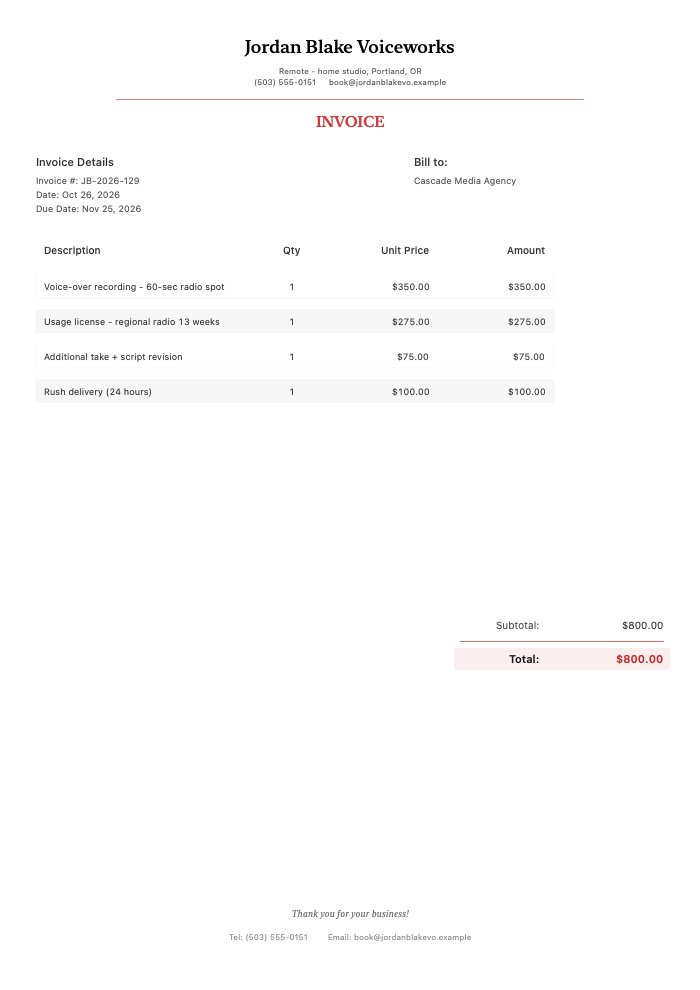
Here’s a voice-over invoice for a 90-second explainer read with web and social usage for one year:
Click to view full size
This invoice shows VO billing done properly:
- The session fee and the usage license as separate lines — the recording charged on its own, and a one-year web + social license charged on top — so the client sees exactly what the rights cost
- The usage scope stated plainly — media, territory, and term — so there’s no ambiguity about what was bought
- One revision round noted as included, setting the boundary before the “just one more” requests start
- A clean $800.00 total with the currency stated, ready to cross borders
Because the session and the rights are split, the client understands they’re paying for where it runs, not just the hour you spent recording — and you’ve captured the full value of the read.
Typical Voice-Over Rates
VO rates vary enormously by market, experience, usage, and union status. These are typical non-union US ranges for guidance — professional rate guides (like the GVAA rate guide) go deeper, and usage fees scale far higher for broadcast.
| Item | Typical Range | Unit |
|---|---|---|
| Explainer / corporate (per finished minute) | $100 – $350 | Per minute |
| Commercial session fee (regional) | $250 – $600 | Per spot |
| E-learning / narration | $150 – $300 | Per finished hour of prep |
| Audiobook | $150 – $400 | Per finished hour |
| Web / social usage license (1 yr) | $200 – $800 | Per license |
| Regional broadcast usage | $500 – $2,500+ | Per market/term |
| IVR / phone system | $150 – $500 | Per project |
| Extra revision round | $50 – $150 | Per round |
| Rush / same-day | 25% – 50% | Surcharge |
Rates vary widely by market, experience, usage scope, and union status. Broadcast and national usage command far higher licensing fees. Consult a current professional rate guide for your market.
How Voice-Over Artists Bill
Most VO pros structure invoices one of these ways:
Session + usage (the standard). You charge a base session fee for the recording and a separate usage fee scaled to where it runs and for how long. This is the professional default because it correctly prices the value of the read, not just the time.
All-in project fee. For projects with limited or internal usage — an explainer that lives on the client’s site, an IVR menu — you quote one number that bundles session and limited usage. Simpler, fine when the usage is modest and won’t expand.
Per finished minute / per finished hour. Common for narration, e-learning, and audiobooks, where the deliverable length is the natural unit. You price per minute or hour of finished audio.
Retainer. For ongoing clients — a brand that needs regular reads — a monthly retainer covers an agreed volume, with usage terms set in the agreement.
Whatever the structure, the usage scope must be written down. The single most expensive mistake in VO is delivering a read with no stated usage limit and watching it run everywhere, forever, on a one-time session fee.
Getting Paid — Including Across Borders
VO work comes from everywhere, which means you’re often invoicing a client three time zones away in a currency that isn’t yours. A clean, professional invoice that states the currency and the usage scope is what gets paid without a chase.
Fast invoicing keeps that friction low. An app like InvoiceZap lets you build a professional VO invoice in about 30 seconds — keep a reusable template with your details, your standard revision policy, and your payment instructions, then drop in the session fee, the usage line with its scope, and any add-ons per project.
Here’s the rhythm with InvoiceZap: you keep a template that already separates session and usage lines, so every invoice prompts you to state the rights. You set the currency to match the client, note the usage scope, send, and mark it paid when it lands — manual payment tracking that keeps your international jobs organized instead of scattered across PayPal, Wise, and email threads.
A few habits that protect VO income:
- Always bill usage as a separate line — never fold it into the session fee silently
- State the usage scope — media, territory, term — on every invoice
- Cap revisions and price extra rounds
- State the currency clearly so international clients pay the right amount
- Treat a usage expansion as a new invoice — more reach means more money
For related freelance billing guidance, see our videographer invoice template, our roundup of the best invoicing software for freelancers, invoice payment terms that get you paid faster, and the complete guide on how to invoice international clients. For a ready layout to start from, see the invoice templates collection.
Frequently Asked Questions
What’s the difference between a session fee and a usage fee?
The session fee pays for the recording itself — your time, performance, and clean delivery to spec. The usage fee pays for where the audio runs and for how long, scaled to the media, territory, and term. The same read is worth far more as a national broadcast campaign than as an internal training clip, so billing usage separately captures the real value of the work rather than just the hour at the mic.
How do I price voice-over usage rights?
Usage scales with reach and duration — a local web video license is a fraction of a national broadcast buyout. Price it by media type (web, social, radio, TV, in-game), territory (local, national, worldwide), and term (one year, perpetual). Professional rate guides for your market give benchmark figures, and the key is stating the exact scope on the invoice so any expansion becomes a new, billable license.
Should I charge extra for revisions?
Yes, beyond an included amount. State how many revision rounds the fee covers — one or two is common — and price additional rounds on the invoice. This protects your time from open-ended “just one more take” requests while still giving the client reasonable room to get the read right, and it sets the expectation before the project starts rather than after.
How do I invoice international voice-over clients?
State the currency clearly, keep the invoice clean and itemized, and give payment instructions that work across borders, such as a service like Wise or PayPal. Note the usage scope so the rights are unambiguous regardless of jurisdiction, and be aware some clients may raise VAT or withholding questions — see our guide on invoicing international clients for the details on handling those.
What’s the fastest way to invoice a voice-over job?
Keep a reusable template that already separates the session fee from the usage line, so every invoice prompts you to state the rights, then add the project details, the usage scope, and any add-ons. An app like InvoiceZap builds the invoice in about 30 seconds, lets you set the client’s currency, and tracks which invoices are paid, keeping your international jobs organized in one place.
The Takeaway
Voice-over is a two-part business: the session pays for the recording, the usage pays for where it runs. Bill only the first and you’re giving away the value that makes VO worth doing. Split the session fee from the usage license, state the scope in writing, cap your revisions, and invoice clean enough to cross borders — and you capture the full worth of every read, not just the hour at the mic.
Ready to invoice your next VO job the professional way? Try InvoiceZap free on your iPhone, iPad, or Mac. Build an invoice that separates session and usage in about 30 seconds, set any currency, and track what’s paid. Download InvoiceZap and start your 3-day trial.
Ready to Streamline Your Invoicing?
Create professional invoices in 30 seconds with InvoiceZap's mobile-first design. No sign-up required.
Try InvoiceZap FreeTags: