You quoted the oak removal at $1,800. Then you got up in the canopy and found it was leaning over the neighbor’s fence, there was a power line closer than the photos showed, and the homeowner asked if you’d “just grind the stump too while you’re here.” The crew’s packing up, everyone’s tired, and now you’re doing invoice math on a truck tailgate trying to remember what was in the quote and what wasn’t.
Tree work is high-skill, high-risk, and priced all over the map — and the invoice is where a good day’s work turns into money, or quietly doesn’t. This guide walks through a tree service invoice template that handles removals, trimming, stump grinding, and emergency calls, the rates crews actually charge, and how to bill the extras without an awkward conversation on the lawn.
Why Tree Service Billing Is Its Own Beast
Most trades have predictable jobs. Tree work has variables stacked on variables, and every one of them affects the invoice.
No two trees cost the same. Height, species, trunk diameter, whether it’s dead or alive, how close it is to a house, a fence, or a power line — all of it changes the price and the risk. A 30-foot pine in an open yard and a 30-foot oak leaning over a roof are completely different jobs at completely different prices. Your invoice has to reflect the actual job, not a generic “tree removal” line.
Access and cleanup are half the cost. Getting equipment to the tree, protecting the lawn, and hauling away the debris often costs as much as the cutting. Crane access, tight backyards, and full log-and-brush removal are real line items. Bury them in one flat number and the client thinks the cutting was the whole job — then balks when you explain.
Scope grows on-site, always. “While you’re here” is the tree industry’s national anthem. Grind the stump, take down that dead limb, trim the hedge by the driveway. Each is legitimate extra work. If your invoice doesn’t itemize the add-ons the client agreed to, you either eat them or fight about them later.
Emergencies are a different price entirely. A storm drops a limb on a garage at 11pm and the client needs it gone now. Emergency and after-hours work commands a premium for a reason — the risk and the schedule disruption are real. That premium belongs on the invoice as its own clearly labeled line, not hidden in an inflated base rate.
You don’t need accounting software to handle this. You need an invoice that itemizes the real job and a way to build it before the crew’s even off the property.
What Belongs on a Tree Service Invoice
A professional tree invoice answers what you did, what it cost, and how to pay — and covers you on the liability side too. Include:
- Your business name, contact, license, and insurance info (tree work clients care about proof of insurance — put your policy reference on the invoice)
- Client name, job-site address, and contact
- Invoice number and issue date
- Job description: which trees, what work, at what address
- Itemized lines: removal, trimming, stump grinding, debris haul, access/equipment, each with a clear description and amount
- Subtotal, tax where it applies, and total due
- Deposit received (if any) and remaining balance
- Payment terms and payment instructions as plain text: check, bank transfer, Venmo, Zelle
- A note line for anything the client should know or agreed to on-site
The insurance reference matters more in tree work than almost anywhere. Homeowners have heard the horror stories about uninsured crews and a tree through the roof. Putting your coverage on the invoice quietly reassures them and reinforces why you’re not the cheapest quote they got.
Sample Line Items: Removal With Extras
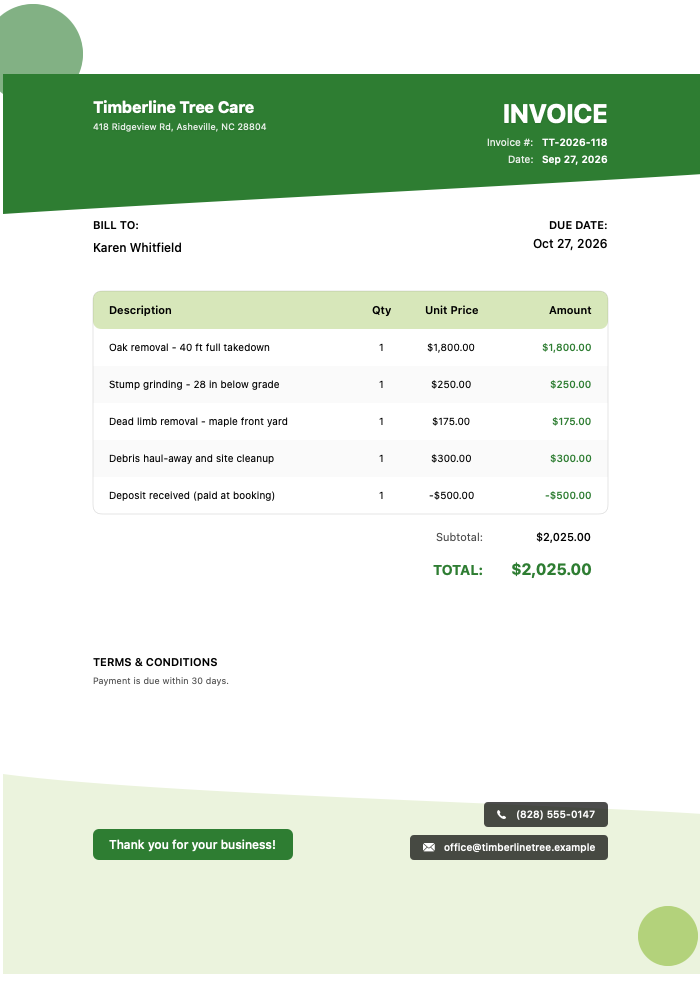
Here’s a clean invoice for an oak removal where the homeowner added a stump grind and a dead limb on-site:
Click to view full size
Every add-on the homeowner requested is its own line. They can see the $1,800 they agreed to, plus the $425 of extras they asked for on the day, plus the cleanup that was always part of the deal. The $500 deposit taken at booking is credited as its own line, so the balance due is $2,025.00. Nothing to argue about.
Typical Tree Service Rates
Rates swing hard with size, risk, access, and region. Storm season and emergency calls run higher. Treat these as a rough guide and price the actual tree in front of you.
| Service | Typical Rate | Unit |
|---|---|---|
| Small tree removal (under 30 ft) | $200–$700 | Per tree |
| Medium tree removal (30–60 ft) | $700–$1,800 | Per tree |
| Large tree removal (60 ft+) | $1,800–$5,000+ | Per tree |
| Tree trimming / pruning | $250–$1,000 | Per tree |
| Stump grinding | $100–$400 | Per stump |
| Stump grinding (per inch) | $3–$7 | Per inch diameter |
| Debris / log haul-away | $50–$150 | Per load |
| Emergency / storm response | +50–100% | Premium on base |
| Crane-assisted removal | $500–$2,000+ | Added to job |
| Cabling / bracing | $200–$600 | Per tree |
| Lot clearing | $1,500–$4,000+ | Per acre |
| Hourly crew rate (small jobs) | $150–$400 | Per hour, crew |
A word on pricing per inch for stumps: it’s transparent and easy for clients to understand, and it protects you on the big ones. A 40-inch stump at $5 an inch is $200, and the client can do that math themselves.
Three Ways to Bill Tree Work
Most crews use all three depending on the job.
Per-job flat rate. You quote a fixed price for a defined scope — this tree, this trimming, this stump — after seeing it in person. This is the standard for tree work and what clients expect. The key is quoting in writing after an on-site look, not over the phone from a photo, because photos hide the lean, the power line, and the backyard access that decide the real price. Scope it tight and quote add-ons separately.
Hourly / crew rate. You bill for crew time plus equipment, usually for small or hard-to-estimate jobs like a morning of assorted trimming. Fair when the scope is genuinely unknown, but clients get nervous watching the clock on a $300-an-hour crew, so set expectations up front and give a not-to-exceed number if you can.
Deposit plus balance. For larger removals, you take a deposit at booking (often to lock the date and cover initial costs) and bill the balance on completion. This protects your cash flow on multi-thousand-dollar jobs and filters out tire-kickers. Show the deposit clearly on the final invoice so the client sees exactly what’s left.
Quick gut check: defined jobs lean per-job flat rate, genuinely unknown scopes lean hourly, and big-ticket removals lean deposit-plus-balance. Before you set terms on a large job, these payment terms are worth a look — a five-figure removal on net 30 with no deposit is a cash-flow trap.
Invoicing Before the Chipper’s Loaded
Here’s the friction: after a hard day in the canopy, the last thing your crew lead wants is to rebuild an invoice from a blank page, remembering which add-ons the homeowner approved. So it waits. Then it waits some more. And the dead-limb line nobody wrote down never gets billed.
This is where InvoiceZap earns its place on a tree crew’s phone. It’s built to send a professional invoice on-site in about 30 seconds — while the homeowner’s standing right there and the work is fresh, so the extras get captured while everyone remembers them. You save the client, pick a template, add your line items, and your insurance and payment details ride along automatically on every invoice. It’s mobile-first for a job that never happens at a desk, and you mark invoices paid yourself as the money comes in, so you always know which jobs are still open. There’s a 3-day full trial to test it on your next removal.
Invoicing on-site also shortens the pay cycle: the client sees a clean, itemized bill while they’re still impressed with the clean yard, instead of a vague number three days later when the goodwill’s faded. If a client does stall, keep a couple of follow-up email templates ready so the reminder takes seconds. And for a structured starting layout that suits trade and contractor work, the contractor invoice template maps closely to how tree jobs bill.
Show Off Your Work: Before/After Photos
Tree work produces genuinely dramatic transformations — an overgrown, hazardous yard turned open and safe, a storm-damaged property made whole again. A single photo undersells it.
Before/after comparisons are your best marketing. They show homeowners exactly what you can do and justify your price against the cheap uninsured guy. Use them in:
- Social media posts and reels
- Client follow-ups
- Your website portfolio
- Your Google Business Profile
Pro tip: shoot the same angle before the crew starts and again once the yard’s cleaned up. Use Before After Photo Compare to make a slider animation people can drag to see the change — far more engaging than a static pair, and a strong closer when you’re bidding the next job.
Wrapping Up
Your value is doing dangerous, skilled work safely and leaving a clean yard behind. Your invoice should carry that same professionalism: itemize the real job, capture the on-site add-ons, show your insurance, and make the balance easy to pay. Build the template once, match the billing model to the job, and stop leaving money on the tailgate.
When you’re ready to bill before the truck pulls away, download InvoiceZap and send your next invoice in about 30 seconds. Start the 3-day trial, invoice your next removal on-site, and get paid while the yard still looks amazing.
Frequently Asked Questions
How should I price a tree removal?
Price it per job after seeing the tree in person, not from a photo. Height, trunk diameter, whether it’s dead or alive, and proximity to structures or power lines all change the price and the risk. Small removals commonly run a few hundred dollars while large or hazardous ones reach several thousand, so quote the actual tree and itemize extras like stump grinding and haul-away separately.
Should I charge a deposit for large tree jobs?
Yes, for larger removals a deposit at booking is standard. It locks in the date, covers your upfront costs, and filters out clients who won’t follow through. Show the deposit clearly on the final invoice as a credit so the client sees exactly what balance remains.
How do I bill for stump grinding?
Stump grinding is usually billed per stump or per inch of diameter, commonly $3 to $7 per inch. Per-inch pricing is transparent and protects you on large stumps since the client can see the math. List it as its own line separate from the removal so add-on stump work is clearly captured.
Do I need to put insurance information on my invoice?
It’s a smart move in tree work. Homeowners worry about uninsured crews and damage to their property, so referencing your liability coverage on the invoice reassures them and reinforces why you’re worth more than the cheapest bid. Include your license number too if your state requires one.
What’s the fastest way to invoice a tree job?
Invoice on-site the moment the work is done, from your phone, while the client is present and the add-ons are fresh. Saving each client once and using a mobile app that pre-fills your business, insurance, and payment details cuts each invoice to about 30 seconds and stops approved extras from slipping through unbilled.
Ready to Streamline Your Invoicing?
Create professional invoices in 30 seconds with InvoiceZap's mobile-first design. No sign-up required.
Try InvoiceZap FreeTags: