A 4,000-word contract lands in your inbox on a Thursday, flagged urgent, needed by Monday. You translate it, proofread it, format it to match the original, and send it back. Then you sit down to invoice — and realize you’re not sure whether to bill per word or per hour, whether to charge the rush rate you mentioned in passing, and whether this particular agency pays in 30 days or 60.
Translators juggle more billing variables than almost any freelancer. Per-word, per-hour, per-page, certified statements, rush surcharges, minimum fees, two or three different currencies — it adds up to a lot of ways to get the invoice wrong. This guide covers a translator invoice template that handles all of it, the rates working translators actually charge, how billing differs between agencies and direct clients, and how to send a clean invoice in the time it used to take to find your spreadsheet.
Why Translation Billing Gets Complicated
Translation is one of the few freelance fields where the unit of work itself is up for debate. A graphic designer bills per project or per hour and that’s roughly the end of it. A translator might bill the same job three different ways depending on who’s asking.
Per-word is the industry default — but “which words?” Most translation is priced per source word (the word count of the original) because it’s known before you start. Some clients and agencies price per target word instead. The two produce different totals, especially between languages that expand or contract when translated. Your invoice needs to state which basis you used and show the word count, or you’ll get a “why is this more than I expected?” email.
Certified translations are a separate product. When a client needs a translation for immigration, a court, or a university, they often need a signed certification statement attesting to accuracy. That’s billable — a flat fee on top of the translation — and it should be its own line, because it’s a distinct deliverable with its own value.
Rush work is real and chargeable. A weekend turnaround or a same-day job disrupts your schedule and bumps other work. A rush surcharge (commonly 20–50% on top) is standard in the industry. Put it on its own labeled line so the client sees it as the premium service it is, not a padded number.
Minimum fees protect small jobs. Translating a birth certificate might be 200 words — not worth firing up for your per-word rate alone. Most translators set a minimum fee (often $25–$50) for small jobs. Make your minimum clear up front so a tiny job doesn’t become an awkward invoice conversation.
Agencies and direct clients pay differently. Agencies usually have fixed per-word rates, purchase order numbers, and net-30 or net-45 terms. Direct clients pay faster, accept higher rates, and often prefer a flat quote. One invoice format won’t flatter both.
You don’t need specialized translation billing software to handle this. You need an invoice that itemizes word count, certification, and rush clearly — and that you can produce in a couple of taps.
What Belongs on a Translator Invoice
A clear translator invoice tells the client what you translated, on what basis you priced it, and how to pay. Include:
- Your name or business name, contact details, and tax ID (or VAT number for EU clients)
- Client name and billing address (and PO number if an agency supplied one)
- Invoice number and issue date, plus a due date tied to your terms
- Language pair — e.g. “English → Spanish” — on the invoice itself
- Word count and pricing basis — “per source word” or “per target word”
- Certification statement fee as its own line, when applicable
- Rush / expedited surcharge on a separate labeled line when it applies
- Formatting, DTP, or layout work itemized if you did more than plain text
- Subtotal, any VAT/GST where applicable, and total due
- Currency stated clearly (critical for cross-border work)
- Payment terms and instructions — bank transfer, PayPal, Wise, card
Stating the language pair and word count directly on the invoice isn’t just tidiness — it’s your record of the exact scope, which matters if the client later disputes the count or asks for a related job.
Sample Invoice: Certified Rush Translation
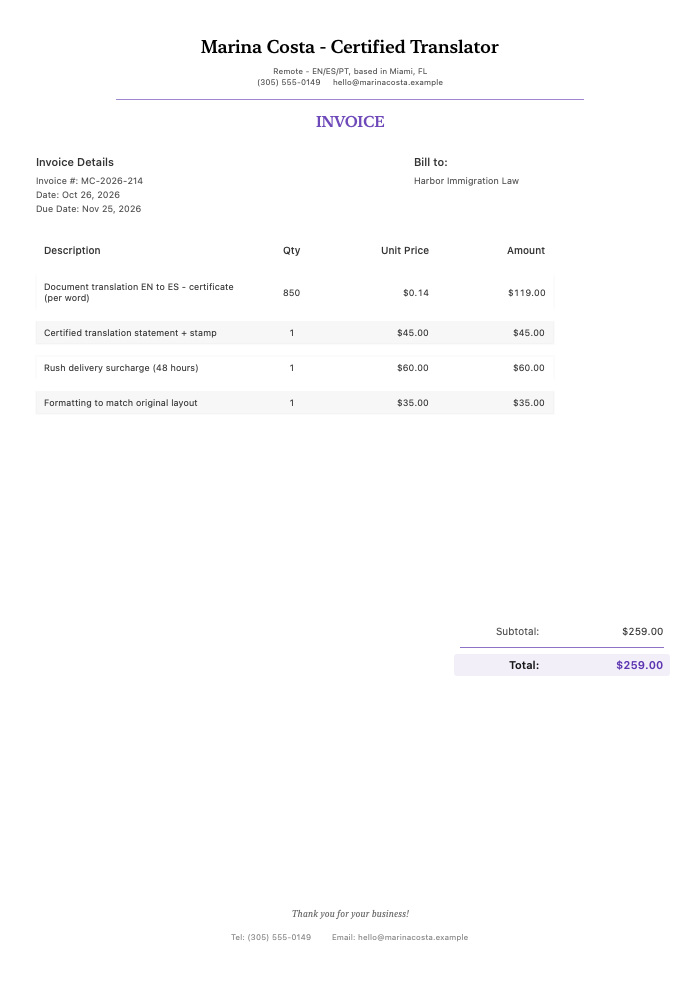
Here’s a translator invoice for a certified document translated under a tight deadline, with formatting to match the original:
Click to view full size
This invoice shows the structure that keeps translation billing transparent:
- The document translation priced per source word — 850 words at $0.14 — with the word count visible so the client can check it
- The certified statement + stamp as its own $45 line, because certification is a distinct deliverable
- A clearly labeled $60 rush surcharge for the 48-hour turnaround
- Formatting to match the original layout itemized separately at $35, for a $259.00 total
Every component of the job is visible and priced on its own terms. There’s no single lump number for the client to question — the word count, the certification, the rush, and the formatting each stand on their own.
Typical Translation Rates
Rates vary enormously by language pair, specialization, and whether you’re billing an agency or a direct client. These are typical US-market ranges — rare language pairs and technical specializations (legal, medical, patent) command the top of each band or well above.
| Service | Typical Range | Unit |
|---|---|---|
| General translation | $0.10 – $0.25 | Per source word |
| Technical / specialized translation | $0.18 – $0.35 | Per source word |
| Certified translation statement | $20 – $75 | Flat per document |
| Rush / expedited surcharge | +20% – 50% | On total |
| Minimum job fee | $25 – $50 | Per small job |
| Proofreading / revision of existing translation | $0.03 – $0.07 | Per word |
| Hourly rate (editing, consultation) | $35 – $90 | Per hour |
| Transcription + translation | $3 – $8 | Per audio minute |
| Formatting / desktop publishing | $25 – $60 | Per hour or flat |
Rates depend heavily on language pair, subject matter, and client type. Direct clients typically pay more than agencies. Always confirm the basis — source vs target word — before quoting.
How Translators Bill
Most translators move between a handful of billing models depending on the job and the client:
Per-word (source). The default for most document work. Known before you start, easy for the client to verify, and the basis agencies almost always use.
Per-hour. Better for editing, proofreading, localization work, or jobs where word count doesn’t reflect effort (heavy formatting, lots of research). Also common for consultation and project management.
Flat project fee. Direct clients often prefer a single quoted number for a defined job. Internally you’re still estimating from word count, but the invoice shows one agreed price — cleaner for the client, and it protects your rate if the text turns out denser than expected.
Per-page (certified / official). Immigration and legal documents are sometimes priced per page rather than per word, especially standardized certificates. State clearly whether “page” means a physical page or a standard 250-word page.
Whichever model you use, name it on the invoice. A client who sees “850 source words × $0.14” understands the total instantly; a client who just sees “$119” starts doing mental math and sometimes emails you about it.
Getting Translation Invoices Paid
Translators face two recurring payment headaches: slow-paying agencies and cross-border friction. Both get easier with a clean, professional invoice sent the moment the job is delivered.
This is where invoicing from your phone or laptop in a couple of taps changes things. Apps like InvoiceZap let you build a professional, itemized translation invoice in about 30 seconds — set up a reusable template with your language pairs, tax ID, and standard payment instructions, then just drop in the word count, certification, and any rush line for each job.
Here’s how it works in practice with InvoiceZap: you keep a saved template with your business details and payment methods, so every invoice starts most of the way done. For a new job you add the language pair, the word count line, and any extras, and the app totals it instantly in the currency you choose — useful when you’re billing a client in euros one day and dollars the next. You send it as a professional PDF, note the terms, and mark it paid when the money lands.
A few habits that get translators paid faster:
- Invoice the day you deliver — the job’s value is freshest in the client’s mind
- State the word count and basis on the invoice so there’s nothing to query
- Confirm the agency’s PO number and net terms before you start, and put the PO on the invoice
- List a low-friction cross-border payment method (Wise, PayPal) alongside bank transfer
- Set and show a minimum fee so small jobs don’t become awkward
For more on the freelance payment cluster, see our guide to invoice payment terms that get you paid faster and the invoice follow-up email templates for chasing slow agencies. If you work with overseas clients, the guide to invoicing international clients covers currency and VAT. And if you’re weighing tools, our roundup of the best invoicing software for freelancers is a good starting point. For a ready-made layout, see the translation & language invoice templates collection.
Frequently Asked Questions
Should translators bill per source word or per target word?
Most translators and agencies bill per source word because the count is known before the job starts, which makes quoting straightforward and verifiable. Per target word is used too, but it produces a different total between languages that expand or shrink when translated. Whichever you use, state the basis and the word count on the invoice so the client can check it.
How much should I charge for a certified translation?
Certified translation involves a signed statement attesting to the accuracy of the translation, typically billed as a flat fee of $20–$75 per document on top of the per-word translation charge. List it as its own line on the invoice, because it’s a distinct deliverable the client needs for official purposes like immigration, court, or academic use.
Is it normal to charge a rush fee for translation?
Yes. A rush or expedited surcharge of 20–50% is standard across the translation industry for weekend, same-day, or tight-deadline work that disrupts your schedule. Put it on its own labeled line on the invoice so the client sees it as the premium service it is rather than an unexplained bump in the total.
How do I handle invoicing translation agencies?
Agencies usually set fixed per-word rates, issue purchase order numbers, and pay on net-30 or net-45 terms. Confirm the PO number and payment terms before you start, put the PO on your invoice, and track the longer payment window so you know when to follow up. Direct clients typically pay faster and accept higher rates.
What’s the best way to invoice international translation clients?
Send a professional PDF invoice the day you deliver, state the currency clearly, and offer a low-friction cross-border payment method like Wise or PayPal alongside a bank transfer. An app like InvoiceZap lets you create the invoice in about 30 seconds and set the currency per client, which helps when you bill in different currencies across jobs.
The Takeaway
Translation billing has more moving parts than most freelance work — per-word versus per-hour, certification, rush, minimums, currencies. The fix isn’t to simplify your pricing; it’s to make every part of it visible on the invoice. State the basis, show the word count, line out the certification and rush, and name the currency.
Ready to stop wrestling with your invoicing spreadsheet? Try InvoiceZap free on your iPhone, iPad, or Mac. Build a professional, itemized translation invoice in about 30 seconds, set the currency per client, and send it the moment you deliver. Download InvoiceZap and start your 3-day trial.
Ready to Streamline Your Invoicing?
Create professional invoices in 30 seconds with InvoiceZap's mobile-first design. No sign-up required.
Try InvoiceZap FreeTags: