
The homeowner on Maple Street pays $140 a month for weekly service. The one on Oak is a snowbird who wants the pool opened in April and closed in October and nothing in between. Then there’s the new lead who called Tuesday because the pump died and the water’s turning green. Three clients, three completely different ways to bill, and you’re running a route in 95-degree heat trying to keep it all straight in your head.
That’s pool service. The work itself you’ve got down cold. The billing is where money quietly leaks out: the extra acid you added and forgot to charge for, the filter clean you did “as a favor,” the monthly client whose card you never got around to running. This guide covers a pool service invoice template that handles all three billing models, the rates pool pros actually charge, and how to stop losing an hour every Sunday to paperwork.
Why Pool Billing Trips People Up
Pool service isn’t one business. It’s three stacked on top of each other, and each one bills differently.
Recurring routes are your bread and butter, and your biggest leak. A weekly or biweekly maintenance client is predictable revenue, which is exactly why it goes on autopilot. You service 40 pools and invoice them all at month-end from memory. Miss one, undercount a visit because a holiday shuffled the schedule, or forget the extra chemicals you dumped in during an algae bloom, and it’s gone. Multiply small misses across a full route and you’re leaving real money in the water.
Chemicals are a moving target. Chlorine, acid, algaecide, shock, stabilizer — costs swing with the weather and the pool. A green pool in July eats three times the chemicals of a well-maintained one. If your invoice bundles “service” into one flat line, you eat that cost. Itemize chemicals separately and the client sees why a bad month costs more, and you stop subsidizing their neglect.
Repairs and one-time jobs don’t fit the monthly rhythm. A pump replacement, a heater diagnosis, an acid wash, a green-to-clean recovery — these are project jobs with parts, labor, and sometimes a markup. Trying to shoehorn a $600 pump swap into a maintenance invoice confuses everyone. It deserves its own invoice with its own line items.
Then there’s seasonality. Openings and closings cluster in spring and fall. Snowbird clients want service on a schedule that isn’t monthly. Your billing has to flex with a calendar that isn’t the same every month.
None of this needs accounting software. It needs an invoice that itemizes properly and a system that doesn’t rely on your memory after a long, hot route.
What Belongs on a Pool Service Invoice
A clean pool invoice answers what you did, what it cost, and how to pay — before the client has to ask. Include:
- Your business name, contact, and license number if your state requires one for chemical handling or repairs
- Client name, service address, and contact (the pool address may differ from the billing address)
- Invoice number and issue date
- Service period or service date — critical for recurring routes
- Itemized lines: service visits, chemicals used, repairs, parts, with quantity, rate, and amount
- Subtotal, tax where it applies (parts and chemicals often are), and total due
- Payment terms (due on receipt, net 15, or auto-bill on the 1st)
- Payment instructions written as plain text: bank transfer, check, Venmo, Zelle
- A note line for anything the client should know — “added extra acid, pH was high after the rain”
That service-period line does more than it looks. On a recurring account it proves exactly which visits this invoice covers, which kills the “wait, didn’t I already pay for that week?” conversation before it starts.
Sample Line Items: Monthly Route Client
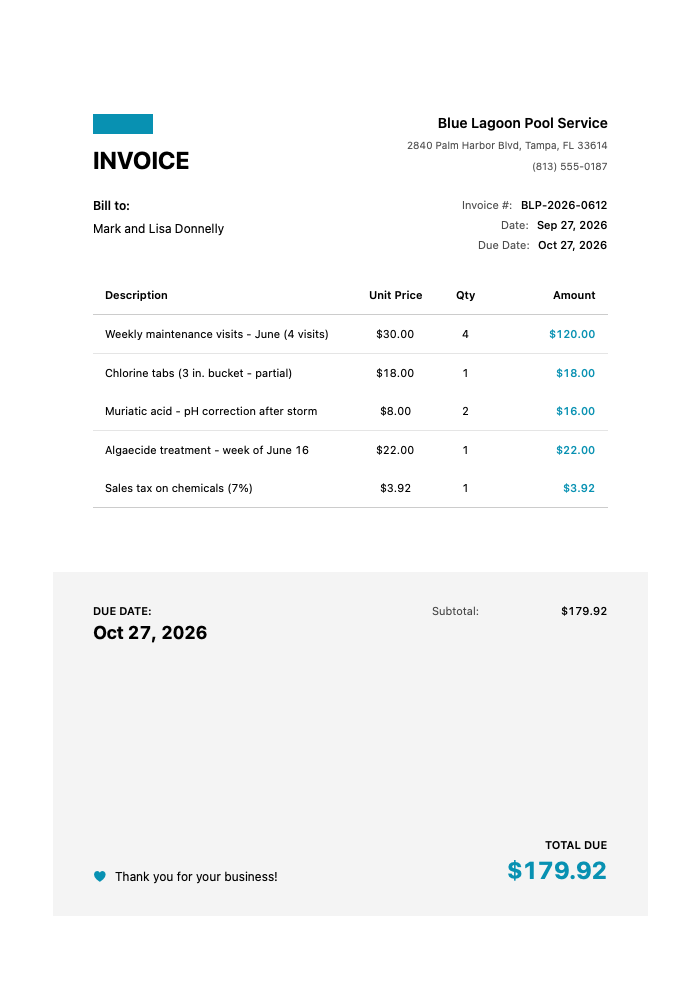
Here’s a clean itemized month for a weekly maintenance client who had one messy week:
Click to view full size
Notice the chemicals sit on their own lines. The client sees the base $120 they expected, plus $56 of extras they can trace to a specific storm. The 7% tax is shown as its own line and applies only to those $56 of chemicals ($3.92), so the total lands at $179.92. No argument, because the invoice already explained itself.
Typical Pool Service Rates
Rates depend on region, pool size, whether it’s chlorine or salt, and how much of a mess you inherited. Treat these as a starting sketch and adjust for your market.
| Service | Typical Rate | Unit |
|---|---|---|
| Weekly maintenance (residential) | $80–$175 | Per month |
| Biweekly maintenance | $60–$120 | Per month |
| One-time clean / tune-up | $100–$250 | Per visit |
| Pool opening (spring) | $150–$400 | Per opening |
| Pool closing (winterization) | $150–$450 | Per closing |
| Green-to-clean recovery | $250–$600+ | Per job |
| Acid wash (drained) | $300–$700 | Per job |
| Filter clean / cartridge service | $75–$150 | Per service |
| Pump repair / replacement | $150–$400 labor | Plus parts |
| Heater diagnosis | $100–$200 | Per visit |
| Salt cell cleaning / replacement | $75–$300 | Per service |
| Chemical delivery / balancing (one-off) | $60–$120 | Per visit |
A note on chemicals: decide early whether your maintenance rate includes standard chemicals or bills them separately. Both are fine. What isn’t fine is being vague, because that’s where the arguments and the write-offs live.
Three Ways to Bill a Pool Client
Most pool pros run all three across their book. The skill is matching the model to the client.
Recurring / flat monthly. The client pays a fixed amount each month for a set service schedule — say $140 for weekly service including standard chemicals. This is the dream for cash flow because you know what’s landing and when. It works best for steady residential and commercial accounts. The catch is scope: spell out what “standard chemicals” covers and what a bad algae month costs extra, so the overage lands on its own line instead of your P&L.
Per-visit. You charge each time you show up. Good for biweekly clients, vacation-home owners, or anyone whose schedule is irregular. Fairer for variable work, but your income swings with the calendar and you have to invoice more often. If you go per-visit, invoice the moment you leave the property while the work is fresh.
Per-job / project. Openings, closings, repairs, and green-to-clean recoveries are quoted as flat jobs with labor plus parts and chemicals. Quote these in writing before you start, especially recoveries, because “the pool was worse than it looked” is a real cost you shouldn’t eat silently. If the scope grows mid-job, quote the addition rather than surprising them on the invoice.
Quick gut check: steady weekly work leans recurring, irregular schedules lean per-visit, and anything with parts or a defined outcome leans per-job. If you’re deciding how aggressive to be on due dates, these payment terms are worth reading before you commit a whole route to net 30.
Making Recurring Invoices Actually Happen
Here’s the honest problem with a 40-pool route: the invoice checklist above is manageable once, and miserable forty times, every month, from memory, after you’ve been in the sun since 6am. That friction is exactly why pool pros fall behind on billing and lose the small stuff.
This is where InvoiceZap fits the way pool work actually runs. It’s built to send a professional invoice from your phone in about 30 seconds — right after you close the gate on a property, not Sunday night at the kitchen table. You save each client once, pick a template, drop in the visit and any chemicals, and your payment details ride along automatically. It’s mobile-first, which matches a job that happens outdoors and on the move, and you mark invoices paid yourself as the money lands so you always know who still owes for the month. There’s a 3-day full trial to test it against your own route before you commit.
Invoicing per-visit instead of batching to month-end also fixes cash flow sideways: money starts arriving through the month instead of in one lump you’re always chasing. When a client does drag their feet, keep a couple of follow-up email templates ready so the nudge takes ten seconds and stays neighborly. And if you want a structured starting layout with services and rates already mapped, the pool maintenance invoice template is built for exactly this kind of route work.
Show Off Your Work: Before/After Photos
Green-to-clean recoveries are some of the most dramatic results in any trade. That swamp becoming crystal-clear water in a day or two is the kind of transformation that sells your next ten jobs — but a single “after” photo doesn’t capture how bad it started.
Before/after comparisons are your best marketing. They prove to skeptical homeowners exactly what you can rescue. Use them in:
- Social media posts and reels
- Follow-up messages to the client
- Your website portfolio
- Your Google Business Profile
Pro tip: shoot the same angle before you touch the pool and again when it’s done. Use Before After Photo Compare to build a slider animation homeowners can drag to see the change. Those get far more engagement than a side-by-side and turn a recovery job into a lead magnet.
Wrapping Up
Your job is keeping other people’s pools clean and running. Your invoice should do the same for your business: capture every visit, itemize the chemicals so a bad month pays for itself, and give repairs their own clean paperwork. Set the template up once, match each client to the right billing model, and the Sunday-night catch-up just disappears.
When you’re ready to stop invoicing from memory, download InvoiceZap and send your next one in about 30 seconds. Start the 3-day trial, bill today’s stops before you drive home, and get your Sundays back.
Frequently Asked Questions
Should pool service be billed monthly or per visit?
It depends on the client. Flat monthly billing suits steady weekly or commercial accounts and gives you predictable cash flow, while per-visit billing fits irregular schedules and vacation homes. Many pool pros run both across their route and quote repairs and openings as separate per-job invoices.
How much should I charge for weekly pool maintenance?
Residential weekly service commonly runs $80 to $175 per month depending on pool size, region, chlorine versus salt, and whether standard chemicals are included. Decide up front whether your rate covers routine chemicals or bills them separately, and always itemize extras like acid or algaecide so a rough month covers its own cost.
Should I itemize chemicals separately on the invoice?
Yes, in most cases. Listing chemicals on their own lines shows the client why a storm month or an algae bloom costs more and stops you quietly absorbing those costs. If you prefer an all-inclusive flat rate, state clearly what it covers and what counts as an extra.
How do I bill for a green-to-clean recovery?
Quote it as a flat per-job price in writing before you start, since recoveries often turn out worse than they look. Break the invoice into labor, chemicals, and any parts so the client sees the work involved, and if the scope grows mid-job, quote the addition rather than absorbing it.
What’s the fastest way to invoice a whole pool route?
Invoice each stop the moment you finish it, from your phone, rather than rebuilding the whole route from memory at month-end. Saving each client once and using a mobile app that pre-fills your details and payment instructions cuts each invoice to about 30 seconds and stops small charges slipping through.
Ready to Streamline Your Invoicing?
Create professional invoices in 30 seconds with InvoiceZap's mobile-first design. No sign-up required.
Try InvoiceZap FreeTags: