
The bride found you on Instagram, loved your portfolio, and booked her wedding eight months out — trial included, full bridal party of five on the day, an early start at the venue an hour away. It’s a beautiful booking. It’s also a logistical and financial commitment that ties up a peak Saturday you can’t resell if she cancels in month seven. So how do you protect that date, charge fairly for the trial, the travel, and the party, and hand her something that looks as polished as your work? The answer isn’t a note in your DMs. It’s a proper invoice with a deposit.
This guide covers a makeup artist invoice template built for how MUAs actually work — bridal packages, event glam, editorial sessions — plus the deposit and travel handling that keeps you from getting burned, the rates artists charge, and how to send it all in about 30 seconds.
Why Makeup Artistry Needs Deposits and Structure
You’re not selling an hour of your time. You’re selling a reserved date, your kit, your skill, and often the peace of mind that the most photographed day of someone’s life will look flawless. That changes how you bill.
You’re reserving irreplaceable time. A Saturday in wedding season is a scarce, perishable asset. Once you hold it for one bride, you turn away others. A non-refundable deposit isn’t greedy — it’s the standard way to price the risk that she cancels and leaves you with an unbookable, unpaid Saturday. No deposit, no date. Full stop.
Trials and the day are separate transactions. A bridal trial is a real appointment, weeks or months before the wedding, with its own time and cost. It should be its own line — sometimes its own invoice — not a freebie you hope leads to a booking. Bundling it invisibly into “the package” trains clients to expect free trials.
Travel is real money. Getting to a 6am venue call with a full kit costs you fuel, time, and often the resale of that morning. On-location and early-start work carries travel and call-out fees, and clients accept them readily when they’re shown as a clear line, not buried.
Party bookings multiply everything. Five bridesmaids plus the bride isn’t one job, it’s six faces on a tight timeline, possibly needing a second artist. Per-person pricing keeps it fair and legible, and it scales your invoice with the actual work.
You don’t need salon software to run a freelance MUA business well. You need an invoice that takes a deposit, separates the trial, shows travel honestly, and prices per person — and that looks as professional as your Instagram grid.
What Belongs on a Makeup Artist Invoice
A professional MUA invoice reassures a client — often a bride spending real money on a high-stakes day — that you’re organized and worth it. Include:
- Your business or artist name and contact (and tax number if you have one)
- Client name and contact
- Invoice number and issue date
- Event date and location — the booking is date-specific, so name it
- Itemized services: bridal makeup, trial, party members, travel, add-ons
- Deposit line — amount paid and clearly marked non-refundable, with the balance shown separately
- Subtotal, tax where it applies, and total due
- Balance-due date — commonly the event day or a set number of days before
- Payment terms and instructions as plain text: bank transfer, card, cash on the day
Showing the deposit as paid and the balance as outstanding removes every “wait, what do I still owe?” conversation. The bride sees exactly what she’s paid to hold the date and exactly what’s due before or on the day.
Sample Line Items: Bridal Package
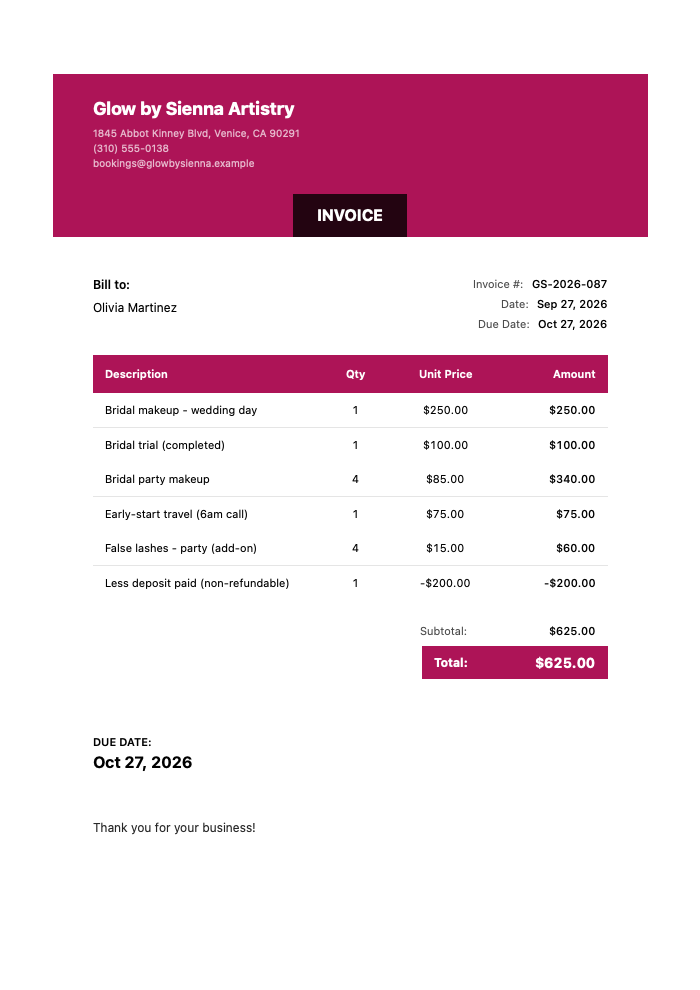
Here’s a clean invoice for a bride plus a small party, with a trial and travel:
Click to view full size
This invoice shows:
- The bride’s $250 wedding-day makeup and the $100 trial she’s already had
- Four bridal party members at $85 each ($340)
- A $75 early-start travel line for the 6am on-location call, and false lashes for the party at $15 each ($60)
- The $200 non-refundable deposit netted off as a negative line, leaving a $625.00 balance to collect on or before the day
Every element is legible: the bride’s own service, the already-completed trial, the four party members, the honest travel line, the lash add-on, and the deposit netted off so the remaining balance is unambiguous.
Typical Makeup Artist Rates
Rates swing widely with location, experience, and whether you’re a rising artist or an established name. Bridal commands a premium over everyday glam because of the stakes and time. Treat these as a sketch.
| Service | Typical Rate | Unit |
|---|---|---|
| Bridal makeup (day of) | $150–$500+ | Per person |
| Bridal trial | $75–$200 | Per session |
| Bridal party / attendant | $65–$150 | Per person |
| Special event / evening glam | $60–$150 | Per person |
| Photoshoot / editorial session | $75–$150 | Per hour |
| Editorial / commercial day rate | $500–$2,000+ | Per day |
| Lesson / one-to-one | $75–$200 | Per session |
| Travel / call-out | $25–$100+ | Per booking |
| Early-start fee (before ~7am) | $25–$75 | Per booking |
| Deposit to reserve date | 25%–50% | Of total |
A note on deposits: 25%–50% non-refundable is standard and it’s what actually protects your calendar. Collect it at booking, before you hold the date — an unpaid “hold” is not a booking.
Billing Deposits, Trials, and Balances
Makeup billing has a rhythm, and the invoice should match it.
The deposit comes first. At booking, you invoice and collect a non-refundable deposit — typically 25%–50% — to reserve the date. This is the single most important habit for a freelance MUA. It filters out flaky enquiries, compensates you if they cancel, and it’s completely normal in the industry. State clearly that it’s non-refundable and that the date isn’t held until it’s paid.
The trial is its own thing. Bill the bridal trial as a separate line, or its own invoice at the time. It’s real work on a real date; treating it as a free extra devalues your time and blurs your numbers. Some artists credit part of it toward the package — that’s fine, just show it explicitly.
The balance is due before or on the day. The remaining balance, after the deposit, is due on a set date — commonly the event day itself or a number of days before. Put that date on the invoice so there’s no ambiguity. For event and editorial clients on terms, these payment terms help you set expectations that keep your cash flow steady.
Quick gut check: deposit at booking, trial billed separately, balance due by the event. Get those three right and you’ve eliminated almost every payment headache in bridal work.
Billing Without Killing the Vibe
Here’s the friction: you’re a solo artist doing the consults, the trials, the early mornings, and the admin. Building a professional invoice with a deposit line, a party breakdown, and a travel fee — for a bride who’s comparing you against artists with polished branding — is exactly the task that gets shoved to “later” and then feels awkward to send. Chasing a deposit over Instagram DMs is nobody’s idea of glamorous.
This is where InvoiceZap fits a beauty business. It’s built to send a clean, itemized invoice from your phone in about 30 seconds — so you can invoice the deposit the moment a bride books, right there in the consult, while she’s excited and committed. You save each client, pick a template, add your bridal, trial, party, and travel lines, and your payment details ride along automatically. It’s mobile-first, made for artists who work on location, not at a desk, and you mark the deposit and the final balance paid yourself as the money lands, so you always know which dates are secured and which balances are still out. There’s a 3-day full trial to test it against your own bookings.
Sending the deposit invoice instantly at booking is what actually secures the date — the faster and more professional the ask, the more real the booking feels. If a balance runs late, a couple of ready follow-up email templates keep the nudge polite and quick. For a layout that fits creative service work, the beauty and creative services invoice template maps neatly onto how MUAs bill.
Your work is visual and transformational — before-and-after is the whole point. If you build a portfolio or share client transformations, Before & After Photo Compare makes clean split and slider comparisons that look great on Instagram and in your booking pitch.
Wrapping Up
Your calendar is your inventory, and a bridal Saturday is the most valuable thing you sell. Protect it with a non-refundable deposit, bill the trial as its own real appointment, show travel and early starts honestly, and price parties per person so the invoice scales with the work. Build the template once, take the deposit at booking every single time, and let the paperwork look as polished as the faces you paint.
When you’re ready to make booking and billing effortless, download InvoiceZap and send your next deposit invoice in about 30 seconds. Start the 3-day trial, secure your next bride’s date on the spot, and keep every balance tracked through to the big day.
Frequently Asked Questions
Should a makeup artist take a deposit for bookings?
Yes, especially for bridal and event work. A non-refundable deposit, commonly 25% to 50% of the total, reserves a date you’d otherwise turn other clients away for and compensates you if the client cancels. It’s standard practice and it protects a scarce, perishable asset — your peak weekend dates. State clearly that the date isn’t held until the deposit is paid.
How do I invoice a bridal trial and the wedding day?
Treat them as separate transactions. Bill the trial as its own line or its own invoice at the time it happens, since it’s a real appointment weeks or months before the wedding. Show the day-of makeup, the trial, and any party members as distinct lines, then net off the deposit so the remaining balance is unambiguous. Some artists credit part of the trial toward the package — just show that explicitly.
How much should a makeup artist charge for a wedding?
Bridal day-of makeup commonly runs $150 to $500 or more per person, with trials at $75 to $200 and party members at $65 to $150 each. Rates depend heavily on location, experience, and reputation, and bridal carries a premium over everyday glam because of the time and stakes. Add clearly labeled travel and early-start fees for on-location work.
When is the balance due for a makeup booking?
After the non-refundable deposit taken at booking, the balance is typically due on the event day itself or a set number of days before it. Put the exact balance-due date on the invoice so there’s no ambiguity, and show the deposit as already paid so the client sees precisely what remains.
What’s the fastest way to invoice makeup clients?
Save each client and use a template so you’re not rebuilding invoices, and send from your phone right in the consult or at booking. A mobile app that pre-fills your details and payment instructions lets you invoice a deposit in about 30 seconds while the client is committed, which is exactly when securing the date matters most.
Ready to Streamline Your Invoicing?
Create professional invoices in 30 seconds with InvoiceZap's mobile-first design. No sign-up required.
Try InvoiceZap FreeTags: