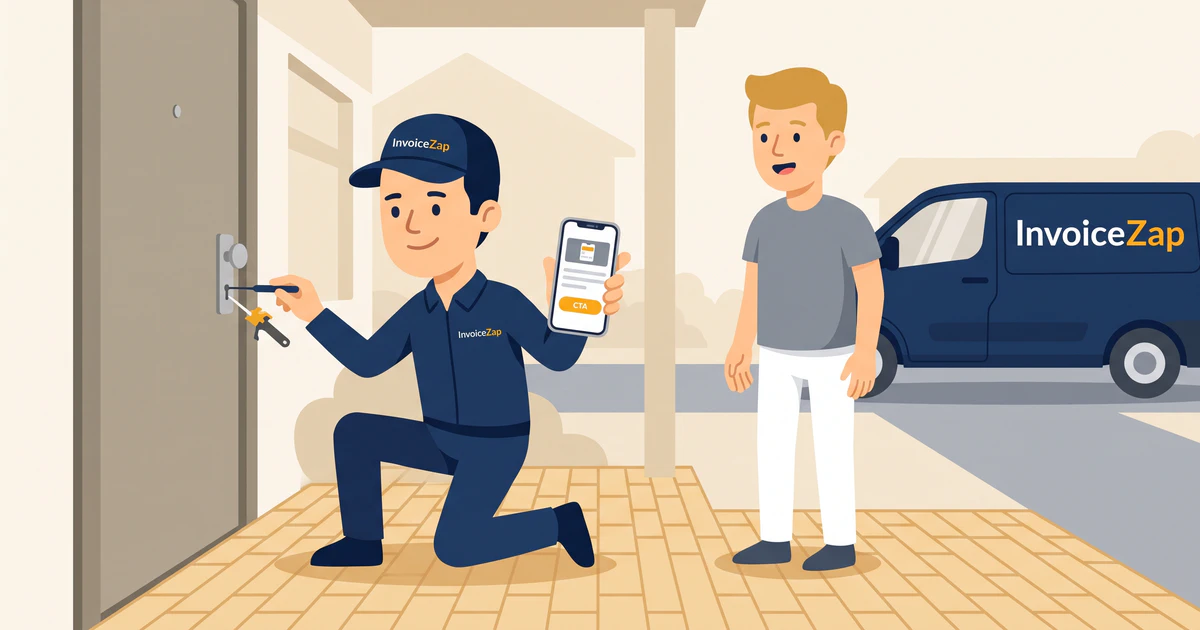
It’s 1am. Someone’s locked out of their house in the rain, they’re stressed, and you’re the one who answered the phone. You get them in, cut a spare, and now comes the part nobody enjoys: explaining the bill on a doorstep to a person who was hoping this would be twenty bucks. Was there a service call fee? An after-hours rate? The rekey they asked for once they were inside?
Locksmithing lives and dies on trust, and the invoice is where trust either holds or breaks. Vague pricing gets you a chargeback and a one-star review; a clean, itemized invoice gets you a repeat customer and a referral to their whole street. This guide covers a locksmith invoice template that handles lockouts, rekeys, installs, and commercial work, the rates locksmiths actually charge, and how to present a bill that feels fair even at 1am.
Why Locksmith Billing Is Tricky
Locksmithing has a reputation problem it didn’t earn — a few bad actors and bait-and-switch operators have made customers suspicious of every bill. That makes your invoice do double duty: it has to charge fairly and prove it charged fairly.
The service call and the work are separate things. You charge to show up. You charge again for what you do once you’re there. Customers who don’t understand this feel ambushed when the $35 “trip fee” they heard on the phone becomes $135 at the door. Itemizing the service call separately from the labor and parts is how you avoid the “but you said $35” fight.
After-hours and emergency rates are real and legitimate. A 1am lockout in a snowstorm is not a Tuesday-afternoon rekey. Emergency and after-hours premiums are standard across the trade. But if that premium is baked invisibly into one number, the customer feels gouged. Put it on its own line, labeled clearly, and it reads as a fair surcharge instead of a scam.
Parts and pricing vary wildly. A basic Kwikset rekey and a high-security Medeco cylinder are worlds apart in cost. Smart locks, commercial panic hardware, and master key systems add parts and complexity. Your invoice needs to itemize hardware separately from labor so the customer sees where their money went.
Commercial work is a different animal. Master key systems, access control, and multi-door rekeys for a property manager aren’t billed like a residential lockout. They often involve quotes, purchase orders, and net-30 terms. One invoice format won’t serve both a panicked homeowner and a facilities manager.
You don’t need heavy software for any of this. You need an invoice that separates the service call, the labor, and the parts — and that you can produce on a doorstep in the dark.
What Belongs on a Locksmith Invoice
A trustworthy locksmith invoice answers what you did, what each piece cost, and how to pay — and it heads off disputes by being transparent. Include:
- Your business name, contact, and license number (many states license locksmiths — display it, it builds trust)
- Customer name, service address, and contact
- Invoice number and issue date / time (time matters for after-hours calls)
- Service call fee as its own line
- Itemized labor: lockout, rekey, install, extraction, each described plainly
- Parts: cylinders, keys, hardware, with quantity and price
- After-hours / emergency surcharge as a separate labeled line if it applies
- Subtotal, tax where it applies to parts, and total due
- Payment terms (due on receipt for residential; net terms for commercial)
- Payment instructions as plain text: card, bank transfer, Venmo, Zelle, check
- A note line — “customer requested rekey after lockout; ID verified”
That last note about verifying ID isn’t just paperwork. Locksmiths who document that they confirmed the customer had a right to access the property protect themselves, and it signals to the customer that you’re a professional, not a break-in artist.
Sample Line Items: After-Hours Lockout + Rekey
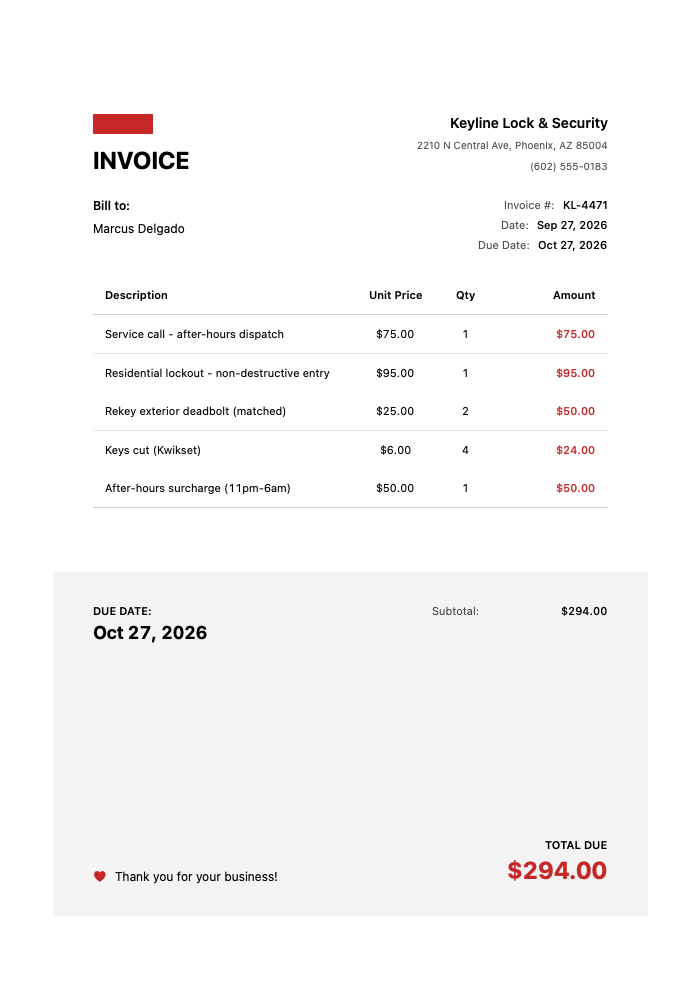
Here’s a clean invoice for a late-night residential lockout where the customer added a rekey once inside:
Click to view full size
This invoice shows:
- The $75 after-hours dispatch fee as its own line
- The $95 non-destructive lockout and the $50 rekey of two matched deadbolts the customer added once inside
- Parts itemized separately — four Kwikset keys at $6 each — so you can add sales tax on parts where your state requires it
- A clearly labeled $50 after-hours surcharge, for a total of $294.00 due on receipt
Every charge is traceable. The customer sees the dispatch fee, the entry work, the rekey they asked for, the keys, and a clearly labeled after-hours line. Nothing hidden, nothing to dispute at the door.
Typical Locksmith Rates
Rates vary by region, security level, and time of day. Emergency and after-hours work runs higher. Treat these as a starting point.
| Service | Typical Rate | Unit |
|---|---|---|
| Service call / trip fee | $35–$100 | Per dispatch |
| Residential lockout | $75–$150 | Per job |
| Car lockout | $75–$150 | Per job |
| Rekey (standard cylinder) | $20–$40 | Per lock |
| Lock installation (deadbolt) | $40–$100 | Per lock, plus hardware |
| Smart lock installation | $80–$200 | Per lock, plus hardware |
| Key cutting (standard) | $3–$10 | Per key |
| Car key / fob programming | $75–$250 | Per key |
| Broken key extraction | $75–$150 | Per lock |
| Safe opening | $150–$400+ | Per job |
| Commercial rekey / master key | $150–$1,000+ | Per system |
| Panic / exit hardware install | $150–$400 | Per door, plus hardware |
| After-hours / emergency surcharge | $50–$150 | Premium on base |
A note on car keys: modern transponder and proximity keys carry a real parts-and-programming cost. Quote these before you cut, because a customer expecting a $10 key and getting a $180 fob is a dispute waiting to happen.
Three Ways to Bill Locksmith Work
Most locksmiths use all three depending on the customer.
Flat per-service. You charge a set price per task — lockout, rekey, install — plus the service call and parts. This is the standard for residential and roadside work, and customers understand it. The key is stating the service call fee up front on the phone and itemizing everything on the invoice, so the total never comes as a surprise.
Hourly (plus parts). You bill for time on complex or open-ended jobs — a difficult safe, a multi-lock diagnosis, a commercial install with unknowns. Fair when the scope is genuinely uncertain, but give the customer a range or a not-to-exceed figure so they’re not watching a meter run with no end in sight.
Quote plus net terms (commercial). For property managers and businesses, you quote the job — a master key system, an access-control install, a building rekey — and bill on completion with net-15 or net-30 terms, often against a purchase order. This is how commercial clients expect to be handled, and it’s very different from the on-the-spot residential model.
Quick gut check: residential and roadside lean flat per-service, complex one-offs lean hourly, and commercial accounts lean quote-plus-net-terms. Before you extend net 30 to a new commercial client, these payment terms are worth a read so you’re not financing a stranger’s building.
Invoicing at the Door, in the Dark
Here’s the friction unique to locksmithing: your customer is often stressed, sometimes it’s the middle of the night, and they want to pay and be done. Fumbling with a paper pad or promising to “email an invoice later” reads as unprofessional and makes late payment likely. But building a clean itemized invoice on a doorstep, by phone light, from scratch? That’s a lot to ask.
This is where InvoiceZap fits the job. It’s built to produce a professional, itemized invoice from your phone in about 30 seconds — right at the door, so the customer sees exactly what they’re paying for while you’re still there. You save the customer, pick a template, drop in the service call, labor, and parts, and your license and payment details ride along automatically. It’s mobile-first for work that happens on the road at all hours, and you mark invoices paid yourself as money lands so you always know what’s outstanding, including your net-terms commercial accounts. There’s a 3-day full trial to test it on your next call.
Invoicing on the spot also protects you: a clear, itemized bill the customer reviews and agrees to in person is your best defense against a chargeback claiming they didn’t know what they were paying for. If a commercial client stretches their terms, keep a couple of follow-up email templates ready to nudge politely. And for a structured layout that suits trade and service work, the handyman and trades invoice template adapts cleanly to locksmith billing.
Wrapping Up
Your business runs on trust, and your invoice is where you prove it. Separate the service call from the labor and parts, label the after-hours premium honestly, note that you verified access, and make it easy to pay on the spot. Set the template up once, match the billing model to the customer, and turn a stressful 1am call into a five-star review.
When you’re ready to bill cleanly at the door, download InvoiceZap and send your next invoice in about 30 seconds. Start the 3-day trial, invoice your next lockout on-site, and give customers a bill they trust.
Frequently Asked Questions
Should a locksmith charge a separate service call fee?
Yes, and you should state it on the phone before dispatch. The service call covers showing up; the labor and parts are billed on top. Listing the trip fee as its own line on the invoice prevents the common dispute where a customer expects the phone-quoted trip fee to be the whole bill.
Is it fair to charge an after-hours or emergency rate?
Absolutely, and it’s standard across the trade. A late-night or holiday call disrupts your schedule and carries more risk. The key is transparency: put the surcharge on its own clearly labeled line rather than hiding it in an inflated base rate, so it reads as a fair premium instead of a scam.
How much should I charge for a rekey?
A standard cylinder rekey commonly runs $20 to $40 per lock plus the service call, with keys cut at a few dollars each. High-security or commercial cylinders cost more. Itemize the rekey, the keys, and the service call separately so the customer sees exactly what makes up the total.
How do I bill commercial locksmith clients?
Commercial work like master key systems and access control is usually quoted in advance and billed on completion with net-15 or net-30 terms, often against a purchase order. This differs entirely from on-the-spot residential billing, so use a separate invoice with clear terms and treat the account like a business relationship.
What’s the fastest way to invoice a lockout on-site?
Build the invoice on your phone at the door while the customer is present, itemizing the service call, labor, and parts as you go. Saving each customer once and using a mobile app that pre-fills your license and payment details cuts each invoice to about 30 seconds and gives the customer a transparent bill they can pay immediately.
Ready to Streamline Your Invoicing?
Create professional invoices in 30 seconds with InvoiceZap's mobile-first design. No sign-up required.
Try InvoiceZap FreeTags: