
The project looked simple when you quoted it: refresh a living room, source a sofa and a rug, done. Six weeks later you’ve spent hours on revisions the client “just wanted to see,” fronted the deposit on a custom console, coordinated three deliveries, and you’re staring at a blank invoice trying to work out how to charge for all of it without either underbilling yourself or scaring the client with a number that looks nothing like the estimate.
Interior design billing is genuinely complicated, more than most creative fields, because you’re charging for your taste and handling other people’s money to buy things. Get the invoice structure right and the whole client relationship runs smoother. This guide covers an interior designer invoice template that handles design fees, procurement, and retainers, the billing models designers actually use, and how to keep your money and the client’s furniture budget cleanly separated.
Why Interior Design Billing Is So Layered
Most freelancers bill for their time or a project fee and that’s the end of it. Interior designers juggle several revenue streams at once, and mixing them up on one messy invoice is how disputes and cash-flow holes appear.
Your fee and their furniture are different money. When you buy a $4,000 sofa on the client’s behalf, that $4,000 isn’t your income — it’s a pass-through. If it lands on the same undifferentiated invoice as your design fee, your books lie to you and the client can’t tell what they’re paying you versus what they’re paying for stuff. Procurement has to be its own clearly separated section.
There are three or four ways to charge, and clients don’t understand any of them. Flat design fee, hourly, cost-plus on furnishings, a markup on retail — most clients have never hired a designer and don’t know how it works. Your invoice is often where they learn how you bill, so it has to be legible, not just accurate.
Revisions and scope creep are constant. “Can we see it in blue?” “What if the bookshelf went there instead?” Each request is real work. Without a defined revision limit and an overage rate, you either eat endless changes or have an uncomfortable conversation months in. The invoice should show extra rounds as their own line so the boundary is visible.
Procurement ties up your cash. You often front deposits to vendors before the client reimburses you. If your billing doesn’t stage deposits and progress payments properly, you’re financing your client’s renovation out of your own pocket, which is a fast route to a cash crunch even on a profitable project.
You don’t need accounting software to manage this. You need an invoice that separates your fee from procurement, stages the payments, and reads clearly to someone who’s never seen a design invoice before.
What Belongs on an Interior Design Invoice
A clear design invoice answers what you did, what it cost, what’s your fee versus their purchases, and how to pay. Include:
- Your studio name and contact (and business/tax number)
- Client name, project address, and contact
- Invoice number and issue date
- Project name or phase — “Living room refresh, Phase 2: procurement”
- Design fee section: your services, however you charge them, clearly labeled
- Procurement section: furnishings bought on the client’s behalf, itemized, with any markup or cost-plus stated
- Reimbursables: samples, delivery, installation, travel
- Deposits received and applied — show what’s already paid
- Subtotal, tax where it applies, and total due
- Payment terms and schedule (deposit, progress, final)
- Payment instructions as plain text: bank transfer, card, check
- A note on remaining project phases or what this payment unlocks
Keeping the design fee and procurement in visually separate sections is the single most important thing. It’s how the client understands that your $2,500 fee bought your expertise, and the $9,000 bought their furniture — two different things that happen to be on one invoice.
Sample Line Items: Design Fee + Procurement Phase
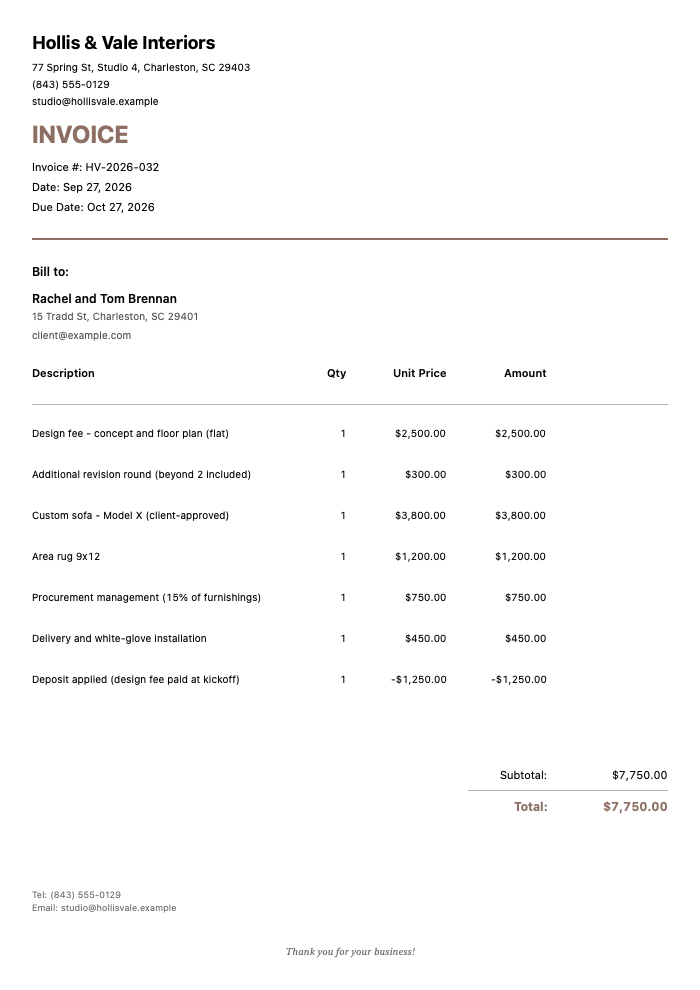
Here’s a clean invoice for a room refresh at the procurement stage, with the design fee already partly paid:
Click to view full size
This invoice shows:
- Design services first: the $2,500 flat design fee and a $300 extra revision round beyond the two included
- Procurement next: the $3,800 custom sofa and $1,200 area rug, plus $750 procurement management (15% of furnishings)
- Reimbursables: $450 delivery and white-glove installation
- The $1,250 design-fee deposit paid at kickoff credited as a negative line, leaving $7,750.00 due
The client can read this top to bottom and understand it: here’s your design work, here’s the furniture you approved, here’s what it cost to get it in the door, and here’s what you already paid. The procurement management line makes your margin on sourcing explicit instead of hidden.
Typical Interior Design Rates
Rates vary enormously by market, experience, and project scale. Treat these as a starting sketch.
| Fee Model | Typical Range | Notes |
|---|---|---|
| Hourly design rate | $75–$250/hr | Higher in major metros |
| Flat design fee (single room) | $1,500–$5,000 | Scope-dependent |
| Flat fee (whole home) | $5,000–$30,000+ | By square footage / rooms |
| Per square foot | $5–$20/sq ft | Common for larger projects |
| Cost-plus markup on furnishings | 10–35% | Added to your cost |
| Retail / trade markup | Keep trade discount | Bill client near retail |
| Procurement management | 10–20% | Of furnishings budget |
| Design retainer (ongoing) | $1,000–$5,000/mo | For staged or long projects |
| e-Design / virtual (per room) | $250–$1,500 | Lower-touch remote service |
| Consultation (one-off) | $150–$500 | Per session |
Pick one furnishings model and stick to it per project. Cost-plus and retail-markup both work; charging both, or being vague about which, is how trust erodes.
Three Ways to Bill Design Work
Most designers use a blend, but per project you should be clear which applies.
Flat design fee. You quote a fixed price for a defined scope — this room, this deliverable set, this many revision rounds. Clients love the predictability, and it rewards you for being efficient rather than slow. The risk is scope creep, so define exactly what’s included (how many concepts, how many revisions, which rooms) and bill anything beyond it as a clear add-on line.
Hourly. You bill for time, best for open-ended work, consultations, or clients who keep changing direction. Fair for unpredictable projects, but clients get anxious watching hours accumulate on creative work they can’t easily judge. If you go hourly, send interim invoices so the number never balloons into a shock.
Retainer. The client pays a fixed monthly amount for ongoing design work across a long or phased project. Excellent for cash flow and for developer or repeat-client relationships. Define the scope each month and bill overflow separately, the same way you’d handle a flat fee that ran long.
Procurement sits alongside whichever fee model you choose — you’re always charging your fee one way, and handling furnishings via cost-plus, markup, or a management percentage. Before you lock terms on a big procurement project, these payment terms are worth reading, because fronting vendor deposits on net 30 is a cash-flow trap dressed as a normal project.
Keeping the Money Straight, Fast
Here’s the friction: a proper design invoice has sections, staged payments, procurement separated from fees, deposits applied — it’s a genuinely fiddly document to build from a blank page every time, per client, per phase. That complexity is exactly why designers put off invoicing and lose track of what they’ve fronted.
This is where InvoiceZap helps. It’s built to turn a professional, itemized invoice out in about 30 seconds from your phone or iPad — the device you’re already carrying to client sites and showrooms. You save each client and project, pick a clean template, itemize your fee and the furnishings separately, and your payment details ride along automatically. It’s mobile-first, so you can invoice a procurement deposit the moment a client approves a piece in the showroom, and you mark invoices paid yourself as money lands, so you always know which deposits and phases are still outstanding. There’s a 3-day full trial to test it against a real project.
Staging your invoices — deposit, procurement, progress, final — instead of one giant bill at the end also fixes the cash-flow squeeze that catches designers fronting vendor money. If a client drifts on a progress payment, keep a couple of follow-up email templates ready so the reminder stays gracious. And if you’re comparing tools built for creative and freelance billing, this rundown of invoicing software for freelancers is a useful reference; for a structured starting layout, the graphic design invoice template shares the creative-project structure you’ll adapt.
Wrapping Up
Your invoice is where a beautiful project becomes a paid one. Separate your design fee from the client’s furniture, make your procurement margin explicit, stage the payments so you’re never financing the renovation yourself, and write it so a first-time design client can actually follow it. Build the template once, pick your fee model per project, and the money stops being the stressful part.
When you’re ready to stop rebuilding complex invoices by hand, download InvoiceZap and send your next one in about 30 seconds. Start the 3-day trial, invoice your next deposit from the showroom floor, and keep the money as polished as the room.
Frequently Asked Questions
Should design fees and furniture purchases be on the same invoice?
They can share an invoice, but they must be in clearly separated sections. Your design fee is your income; furnishings bought for the client are a pass-through. Splitting them into distinct sections lets the client see what they’re paying you versus what they’re paying for products, and keeps your own books honest.
Should interior designers charge flat fee or hourly?
Both work. Flat fees suit defined-scope projects and reward efficiency but require tight scope and revision limits to prevent creep. Hourly suits open-ended or frequently changing work but makes clients anxious as hours mount. Many designers use flat fees per phase and reserve hourly for consultations and out-of-scope requests.
How do designers charge for furniture and procurement?
Common approaches are cost-plus (your cost plus a 10–35% markup), retail markup (you keep your trade discount and bill the client near retail), or a procurement management fee of 10–20% of the furnishings budget. Pick one model per project and state it clearly on the invoice rather than combining approaches.
How should I handle revisions in my billing?
Define how many revision rounds are included in your fee, then bill additional rounds as a clear add-on line at a stated rate. This keeps the boundary visible without you having an awkward conversation months into the project, and it stops endless “just one more version” requests from eating your margin.
What’s the fastest way to invoice a design project?
Stage your invoices — deposit, procurement, progress, final — and build each from a saved client and template rather than a blank page. A mobile app that pre-fills your details and separates fees from furnishings lets you send a professional, sectioned invoice in about 30 seconds, even from a showroom or client site.
Ready to Streamline Your Invoicing?
Create professional invoices in 30 seconds with InvoiceZap's mobile-first design. No sign-up required.
Try InvoiceZap FreeTags: