
Gutter cleaning is a deceptively good business: the job takes an hour or two, the customer can’t do it themselves without risking a fall, and every house needs it at least twice a year. The catch is the billing. A gutter job is small enough that spending twenty minutes writing an invoice kills your margin, but it adds up fast once you’re doing five or six houses a day — and the customers you want are the ones who book you every spring and fall, which means your invoicing has to make the repeat booking effortless.
This guide covers a gutter cleaning invoice template built for speed and repeat work: per-linear-foot and flat-rate pricing, the downspout and guard add-ons that lift your ticket, and how to turn a one-time clean into a seasonal customer with a clean invoice and a before/after photo.
Why Gutter Billing Is a Volume Game
Unlike a four-figure fence job, a gutter clean is a small ticket done many times. That changes what the invoice needs to do:
Speed matters more than detail. At $150–$350 a job and several jobs a day, you can’t spend twenty minutes invoicing each one. The invoice has to be near-instant — a reusable template you fill in on the ladder, not a form you build from scratch.
Pricing scales with the house. A single-story ranch and a two-story colonial are different jobs. Most pros price by linear footage, by stories, or as a flat rate per house size — the invoice should reflect whichever you use so the number makes sense to the customer.
Add-ons are where the margin lives. The base clean is the hook. Downspout flushing, gutter guard installation, minor repairs, roof debris removal, and a second-story surcharge are where a $180 job becomes a $345 one. Each belongs on the invoice as its own line so the customer sees the value.
Repeat booking is the whole business. The profit in gutter cleaning is the customer who books you every spring and fall without shopping around. Your invoice is a touchpoint — a clean, professional one with a before/after photo is what earns the “same time next season” text.
Access and condition vary. Steep roofs, heavy debris, and neglected gutters take longer and carry more risk. A condition-based surcharge, stated up front, keeps a nightmare job from eating your day for a flat-rate price.
The winning setup isn’t complex software — it’s a fast, repeatable invoice that itemizes the clean and its add-ons, and makes rebooking a one-tap decision for the customer.
What Belongs on a Gutter Cleaning Invoice
A good gutter invoice is quick to produce and clear to the customer. Include:
- Your business name, contact, and any license/insurance note
- The customer’s name and the service address
- Invoice number and date
- The base clean — priced by footage, stories, or flat rate for the house size
- Add-ons — downspout flushing, gutter guards, repairs, roof debris — itemized
- Any condition or second-story surcharge, stated
- Subtotal, tax where applicable, and total
- Payment terms and instructions
- A rebooking note — “We recommend cleaning again in spring; reply to rebook”
That rebooking line is small and quietly powerful. Dropping a gentle “we recommend your next clean around April” on the invoice plants the seasonal habit — and the next job often comes without you lifting a finger.
Sample Invoice: Two-Story Gutter Clean + Downspouts
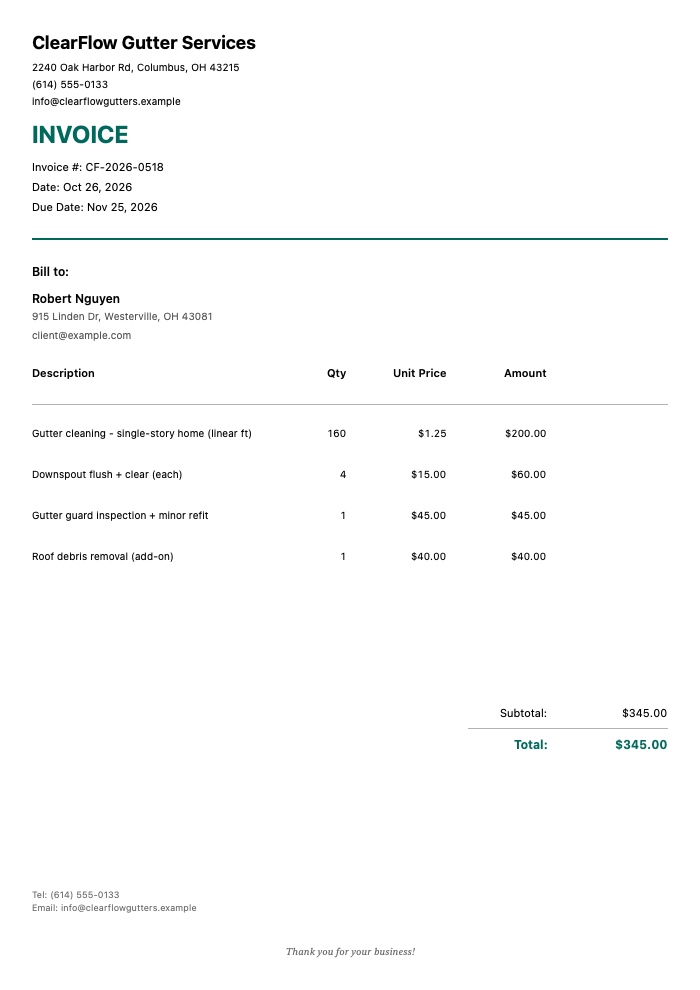
Here’s a gutter cleaning invoice for a two-story home with downspout flushing and a debris-removal add-on:
Click to view full size
This invoice shows how a small-ticket service bills cleanly:
- The base clean priced by the house size, so the number matches what the customer expected from the quote
- Downspout flushing and roof debris removal as separate add-on lines, showing the extra value rather than hiding it in one lump
- A second-story surcharge stated plainly, so the access difficulty is accounted for and not a surprise
- A tidy $345.00 total with a rebooking note that sets up the next seasonal visit
Because the add-ons are visible, the customer understands why this clean cost more than a single-story base — and sees exactly what they got for it.
Typical Gutter Cleaning Rates
Gutter pricing varies by home size, stories, roof pitch, debris level, and region. These are typical US ranges — price against your local market and the risk of each job.
| Item | Typical Range | Unit |
|---|---|---|
| Single-story gutter clean | $70 – $200 | Per house |
| Two-story gutter clean | $100 – $350 | Per house |
| Per linear foot (clean) | $0.80 – $2.00 | Per ft |
| Downspout flushing | $10 – $20 | Per downspout |
| Gutter guard installation | $5 – $12 | Per ft |
| Roof / debris removal | $50 – $150 | Add-on |
| Minor gutter repair / resealing | $75 – $200 | Per job |
| Second-story / steep-roof surcharge | 20% – 50% | On base |
Rates vary by home size, number of stories, roof pitch, debris level, and region. Heavy debris, difficult access, and steep roofs raise the price. Always account for the risk and time of each job.
How Gutter Cleaners Bill
Most gutter pros use one of these pricing models:
Flat rate by house size. You quote a set price for a single-story, two-story, or large home. Fast to quote and easy for customers to understand — the most common model for residential routes.
Per linear foot. You measure (or estimate) the gutter run and price per foot. More precise for unusual homes and useful when combined with per-foot guard installation.
Base + add-ons. Whichever base you use, the real ticket comes from stacking add-ons — downspouts, guards, debris, repairs. This is where margin lives, and the invoice should make each add-on visible so the customer sees the value rather than questioning the total.
Seasonal / maintenance plan. The gold standard: the customer signs up for spring and fall cleans at a slight discount, and you bill each visit automatically. Predictable revenue, no re-selling. Your invoice references the plan so the customer sees they’re getting their member rate.
Across all of these, the move that compounds is turning one-time jobs into seasonal ones. A fast, professional invoice with a rebooking nudge is the cheapest marketing you have.
Show the Result: Before/After Photos
Gutter cleaning is a visual-results business — a gutter choked with leaves and seedlings versus a clean, clear channel is a dramatic before/after, and that image does more selling than any pitch.
Before/after photos are your best marketing. They prove the work and justify the price. Use them for:
- Social media and neighborhood groups
- Your website and Google Business Profile
- Follow-up messages that win the next clean
- Showing the customer what they couldn’t see from the ground
Pro tip: snap the clogged gutter before you start and the clear one after, from the same angle. Use Before After Photo Compare to build a drag-to-reveal slider of the transformation — attaching that to your invoice or follow-up makes the value undeniable and gets you remembered when the leaves fall again.
Getting Paid Fast and Rebooked
On a small, quick job, the goal is to get paid before you leave and booked again before you forget. A fast invoice does both.
That’s where speed-first invoicing pays off. An app like InvoiceZap lets you produce a professional gutter invoice in about 30 seconds — keep a reusable template with your base prices and standard add-ons, then tap in the house size, the add-ons, and send before you’ve packed the ladder.
Here’s the on-route rhythm with InvoiceZap: you keep a template with your base-clean prices and add-on lines ready, fill in the job at the curb, show the customer the total on your phone, take payment, and mark it paid. Add the rebooking note and the before/after photo, and the next seasonal visit is half-sold already — all tracked in one place instead of a glovebox full of receipts.
A few habits that keep a gutter route profitable:
- Keep a template per house size so each invoice is seconds, not minutes
- Itemize add-ons so the customer sees the value, not just a bigger number
- Add a rebooking nudge to every invoice to plant the seasonal habit
- Attach a before/after to prove the work and justify the price
- Collect on-site while you’re still there
For related service billing, see our guides on the window cleaning invoice template, the pressure washing invoice template, and the landscaping invoice template. For a ready layout to start from, browse the invoice templates collection.
Frequently Asked Questions
How do gutter cleaners price a job?
Most price by house size (flat rate for single-story, two-story, or large homes), by linear foot of gutter, or a base rate plus add-ons. The base clean matches the quote, and add-ons like downspout flushing, gutter guards, and debris removal lift the ticket. A second-story or steep-roof surcharge accounts for the extra time and risk, and it should be stated up front so it isn’t a surprise on the invoice.
What add-ons should I offer with gutter cleaning?
The margin in gutter cleaning comes from add-ons: downspout flushing, gutter guard installation, roof and debris removal, and minor repairs or resealing. Itemize each on the invoice so the customer sees the value they’re getting rather than questioning a single larger number, and offer them at the quote stage so they’re part of the job from the start.
How do I turn one-time customers into repeat clients?
Add a rebooking nudge to every invoice — a gentle “we recommend your next clean around April” — and offer a seasonal plan where customers sign up for spring and fall visits at a slight discount. A clean, professional invoice paired with a before/after photo keeps you memorable, so when the leaves fall the customer texts you instead of shopping around.
Should I charge more for a two-story house?
Yes. A second story means more time, a taller ladder, and more risk, so a surcharge of 20%–50% on the base is standard. State it up front at the quote and show it as a clear line on the invoice, so the customer understands the higher price reflects the access difficulty rather than an arbitrary markup.
What’s the fastest way to invoice a gutter job on-site?
Keep a reusable template with your base prices by house size and your standard add-on lines, then fill in the job at the curb and show the customer the total on your phone. An app like InvoiceZap builds the invoice in about 30 seconds, lets you take payment on-site, and tracks what’s paid — so you can invoice five or six houses a day without the admin eating your margin.
The Takeaway
Gutter cleaning is a volume game won on speed and repeat business. A fast, templated invoice that itemizes the clean and its add-ons gets you paid before you leave the driveway; a rebooking nudge and a before/after photo turn that one-time job into a customer who books every spring and fall. The admin should take seconds — so you can do the next house and the one after that.
Ready to invoice a full route without the paperwork drag? Try InvoiceZap free on your iPhone, iPad, or Mac. Build a professional gutter invoice in about 30 seconds, save templates by house size, take payment on-site, and track what’s paid. Download InvoiceZap and start your 3-day trial.
Ready to Streamline Your Invoicing?
Create professional invoices in 30 seconds with InvoiceZap's mobile-first design. No sign-up required.
Try InvoiceZap FreeTags: