Walk-up service at a festival is cash and card, no invoice in sight. But the moment someone books your truck for a wedding, a corporate lunch, or a birthday party, you’re in a different business — one where a deposit holds the date, a contract sets the terms, and an invoice has to spell out per-head pricing, travel, a minimum, and what the balance is on the day. Get that invoice right and private events become your most profitable, most predictable income. Get it vague and you’re arguing about the bill while the band is loading out.
This guide covers food truck invoicing for catering and private events: how to price per head versus flat fee, how to structure deposits that protect your date, the add-ons that belong on the bill, and how to produce a clean invoice on-site when the event wraps.
Why Event Catering Billing Is Its Own Thing
Your daily service doesn’t need invoices — customers pay at the window. Event and catering work is the opposite: it’s booked in advance, priced as a package, and paid in stages. That brings a set of billing concerns walk-up service never touches:
The deposit holds the date. When someone books your truck for a Saturday in June, you’re turning down other work for that slot. A deposit — often a quarter to a half of the estimate — makes the booking real and protects you if they cancel. Your invoice has to show the deposit collected and the balance remaining.
Per-head or flat fee changes everything. Catering is usually priced per guest (with a guaranteed minimum headcount) or as a flat buyout for a set window. Each needs to be stated clearly: a per-head price with the guaranteed count, or a flat fee with what it includes. Mixing them up is how you end up underpaid for a big crowd.
Minimums protect small bookings. Rolling the truck out, staffing it, and prepping food has a fixed cost regardless of how many show up. A stated minimum — “$750 minimum, or 50 guests at $15” — means a small turnout doesn’t leave you in the red.
Travel and overtime are real. Driving the truck two hours each way, or staying an extra hour because the speeches ran long, costs you. These belong on the invoice as named lines, agreed in advance, not sprung at the end.
Sales tax varies. Prepared food is taxed in most states, and event catering may be taxed differently from walk-up sales. Your invoice should show tax as its own line so the total is defensible.
None of this requires catering-management software. It requires an invoice that states the package, the headcount basis, the add-ons, the deposit, and the balance — in terms the client agreed to when they booked.
What Belongs on a Food Truck Catering Invoice
A trustworthy event invoice reads like the booking agreement, itemized. Include:
- Your truck/business name, contact, and permit or license number
- The client’s name and the event date, time, and location
- Invoice number and date
- The catering package — per-head rate with guaranteed count, or flat fee
- Menu or service description — what’s included
- Add-ons — extra service hours, travel/mileage, staffing, rentals — itemized
- Subtotal
- Sales tax as its own line where applicable
- Deposit received shown as a credit
- Balance due and the due date
- Payment terms and instructions
- Cancellation terms — how the deposit is handled if they cancel
The cancellation line matters as much as the price. If the client knows the deposit is non-refundable inside 14 days, they treat the booking seriously — and you’re protected when life happens.
Sample Invoice: Private Event Catering
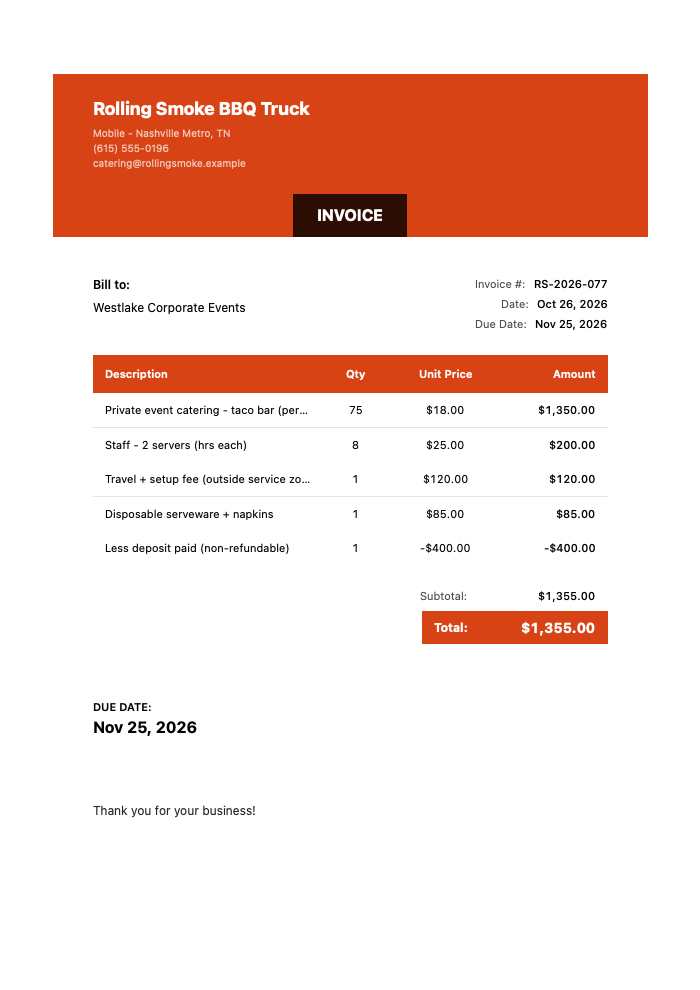
Here’s a food truck invoice for a 70-guest private event with a per-head package, a travel fee, and a deposit already collected:
Click to view full size
This invoice shows event billing done right:
- 70 guests at a $15 per-head rate stated against the guaranteed count, so the headcount basis is unambiguous
- A travel fee and extra service hour itemized as their own lines, agreed up front rather than tacked on
- Sales tax shown as its own line, keeping the total defensible
- The $400 deposit credited against the subtotal, leaving a clear $1,355.00 balance due on the event date
Because every line maps to the booking the client agreed to, the balance gets paid on the day without a “wait, what’s this?” conversation.
Typical Food Truck Catering Rates
Catering pricing varies hugely by cuisine, region, headcount, and service style. These are typical US ranges — price against your food costs, labor, and local market.
| Item | Typical Range | Unit |
|---|---|---|
| Per-head catering (casual) | $12 – $25 | Per guest |
| Per-head catering (premium) | $25 – $45 | Per guest |
| Flat-fee buyout (2–3 hr window) | $750 – $2,500 | Per event |
| Event minimum | $500 – $1,500 | Per event |
| Deposit to hold date | 25% – 50% | Of estimate |
| Travel / mileage (beyond local) | $1 – $3 | Per mile |
| Extra service hour | $100 – $250 | Per hour |
| Additional staff | $20 – $35 | Per hour, per person |
Rates vary by cuisine, portion size, service style, region, and season. Peak weekend dates command premiums. Always price against current food and labor costs.
How Food Trucks Bill for Events
Most mobile vendors use one of these structures:
Per head with a guaranteed minimum. The client gives a headcount, you price per guest, and a guaranteed minimum count protects you if fewer show up. Standard for weddings and larger parties. The final invoice reconciles against the guaranteed count, not the no-shows.
Flat-fee buyout. The client pays a set fee for your truck for a defined window — common for corporate events and private parties where the host covers everyone. Simple to bill; just be clear what’s included and what counts as overtime.
Hybrid with a minimum. A per-head price with a stated floor — “$15/head, $750 minimum.” Covers you for small turnouts while scaling up for big ones. The invoice shows whichever applies.
Deposit + balance, always. Whichever pricing you use, events are almost always deposit-plus-balance: a deposit to book, the balance due on or before the event. The invoice shows the deposit as a credit so the client sees exactly what’s left.
The through-line: the invoice should reconcile to the booking agreement. If the client can trace the final number back to what they agreed to when they paid the deposit, you get paid on the day.
Getting the Balance Paid on the Day
The event’s winding down, the guests are fed and happy, and the organizer is in a good mood — that’s the moment to settle the balance. A clean invoice on your phone turns that goodwill into payment before everyone scatters.
Building the invoice on-site is the trick. An app like InvoiceZap lets you produce a professional catering invoice in about 30 seconds — keep a reusable template with your permit number, cancellation terms, and payment instructions, then drop in the package, headcount, add-ons, and the deposit credit for each booking.
Here’s how it works with InvoiceZap in practice: when the client books, you send an invoice showing the deposit due and mark it paid when it lands. On the event day, you add the final headcount line, any overtime or travel, apply the deposit as a credit, and show the client the balance due on your phone. They pay, you mark it settled, and the booking’s closed before you pull away.
A few habits that keep event money clean:
- Always take a deposit and show it credited on the final invoice
- State the headcount basis — guaranteed count or flat fee — so there’s nothing to argue
- Itemize travel, overtime, and staffing as agreed-in-advance lines
- Put cancellation terms on the invoice so the deposit is understood
- Settle the balance on the day, while the organizer’s still smiling
For related small-business and event billing, see our guides on invoicing as an Etsy seller, farmers market and craft fair vendor invoicing, and the event planner invoice template for booking and package billing. For a ready-made layout to start from, browse the invoice templates collection.
Frequently Asked Questions
Should a food truck charge per head or a flat fee for catering?
Both are standard; it depends on the event. Per-head pricing with a guaranteed minimum count suits weddings and larger parties where the headcount is known, while a flat-fee buyout suits corporate events and private parties where the host covers a set window. State clearly which basis applies on the invoice so the final total is easy to reconcile against the booking.
How much deposit should I take to hold an event date?
Most food trucks take 25%–50% of the estimate as a deposit to secure the date, since booking an event means turning down other work for that slot. Show the deposit as a credit on the final invoice and state your cancellation terms so the client understands how it’s handled if they cancel — commonly non-refundable inside a set window before the event.
Do I need an event minimum?
A minimum protects you on small bookings, because rolling out and staffing the truck has a fixed cost regardless of turnout. State it alongside your per-head price — for example “$15 per guest, $750 minimum” — so a low headcount still covers your costs, and the invoice simply applies whichever figure is higher.
How do I bill for travel to an event?
Bill travel beyond your local area as a named line, typically per mile or as a flat trip fee agreed when the client books. Putting it on the invoice as a line the client already approved avoids any surprise, and keeps your margin intact on events that are a long drive from your usual pitch.
What’s the fastest way to invoice an event when it wraps?
Keep a reusable template on your phone holding your permit number, cancellation terms, and payment instructions, then add the final headcount, any overtime or travel, and apply the deposit as a credit. An app like InvoiceZap builds the catering invoice in about 30 seconds and shows the balance due, so you can collect from the organizer on the day before everyone leaves.
The Takeaway
Walk-up service pays at the window; events pay on terms. The moment you’re booked for a wedding or a corporate lunch, your invoice becomes the agreement made concrete — per-head or flat fee, the add-ons, the deposit credited, the balance due. State it the way the client booked it and the balance gets paid on the day, leaving events as the reliable, high-margin side of the business they should be.
Ready to invoice your next catering gig before you drive off? Try InvoiceZap free on your iPhone, iPad, or Mac. Build a professional event invoice in about 30 seconds, credit the deposit, and show the balance due clearly. Download InvoiceZap and start your 3-day trial.
Ready to Streamline Your Invoicing?
Create professional invoices in 30 seconds with InvoiceZap's mobile-first design. No sign-up required.
Try InvoiceZap FreeTags: