
A homeowner calls wanting 120 feet of cedar privacy fence, a gate, and the old chain-link hauled away. You quote it, they agree, you spend two days in their backyard sinking posts in the cold. Then you write up the bill — and the whole thing hinges on whether your invoice makes the price feel like a fair quote they already agreed to, or a wall of numbers that sparks a “wait, why is it this much?” conversation on the back patio.
Fencing is a materials-heavy trade with real labor behind it, which makes the invoice do heavy lifting. Lumber, posts, concrete, gates, removal, permits — each is a line the customer wants to understand. This guide covers a fence contractor invoice template built around per-linear-foot pricing, how to handle deposits and progress billing on bigger jobs, the rates fencing pros actually charge, and how to produce a clean invoice on-site before you load up the truck.
Why Fencing Billing Needs Structure
Fence jobs sit in an awkward middle ground. They’re bigger than a typical service call — often a few thousand dollars — but shorter than a full construction project. That means they carry construction-style billing concerns (deposits, materials, permits) without the formal draw schedules of a big build.
A few things make fencing invoices trip up:
Materials and labor are both substantial. On a fence job, materials can be close to half the bill. Customers can price lumber and panels at the hardware store, so if you blend materials and labor into one number, the labor looks inflated. Breaking out materials per linear foot and labor per linear foot keeps the math transparent and defensible.
Per-linear-foot is how customers think about fencing. Nobody quotes a fence as “one fence.” It’s priced by the foot, by the material, and by the height. Your invoice should echo that — show the linear footage and the per-foot rate — so the number reconciles with the quote they agreed to.
Removal and disposal are separate work. Tearing out an old fence and hauling it to the dump is labor and a dump fee, not part of the install. Line it separately. Customers who assumed removal was “included” appreciate seeing exactly what it cost rather than finding it baked invisibly into the total.
Gates, permits, and extras add up. A walk gate with hardware, a double drive gate, a permit the municipality required — these are real costs that belong on their own lines. Permit fees especially should show as a passthrough so the customer knows it went to the city, not your pocket.
Bigger jobs need a deposit. You’re fronting thousands in materials before you install anything. A deposit (commonly a third up front, sometimes a 50/50 split) protects your cash flow. The invoice needs to show the deposit already collected and the remaining balance clearly.
You don’t need heavy project software for a fence job. You need an invoice that itemizes materials, labor, removal, and gates — and reflects any deposit already paid.
What Belongs on a Fence Contractor Invoice
A trustworthy fencing invoice reconciles cleanly with the quote and shows the customer where every dollar went. Include:
- Your business name, contact, and contractor license number (required in most states for jobs over a threshold)
- Customer name and the job site address
- Invoice number and date
- Fence specs — material, height, and total linear footage
- Materials line(s) — priced per linear foot or itemized, with quantity
- Installation labor — per linear foot or as a labor total
- Old fence removal + haul-away as its own line when applicable
- Gates — each gate itemized with hardware
- Permit fees shown as a passthrough
- Subtotal, tax where your state taxes materials and/or labor, and total
- Deposit received and balance due, shown clearly
- Payment terms — balance due on completion is standard
- Payment instructions and any workmanship warranty note
The warranty note earns its space. A stated warranty — “1-year warranty on workmanship” — reassures the customer at the moment they’re handing over a four-figure balance and sets a clear boundary on what you’ll come back for.
Sample Invoice: Cedar Privacy Fence + Gate
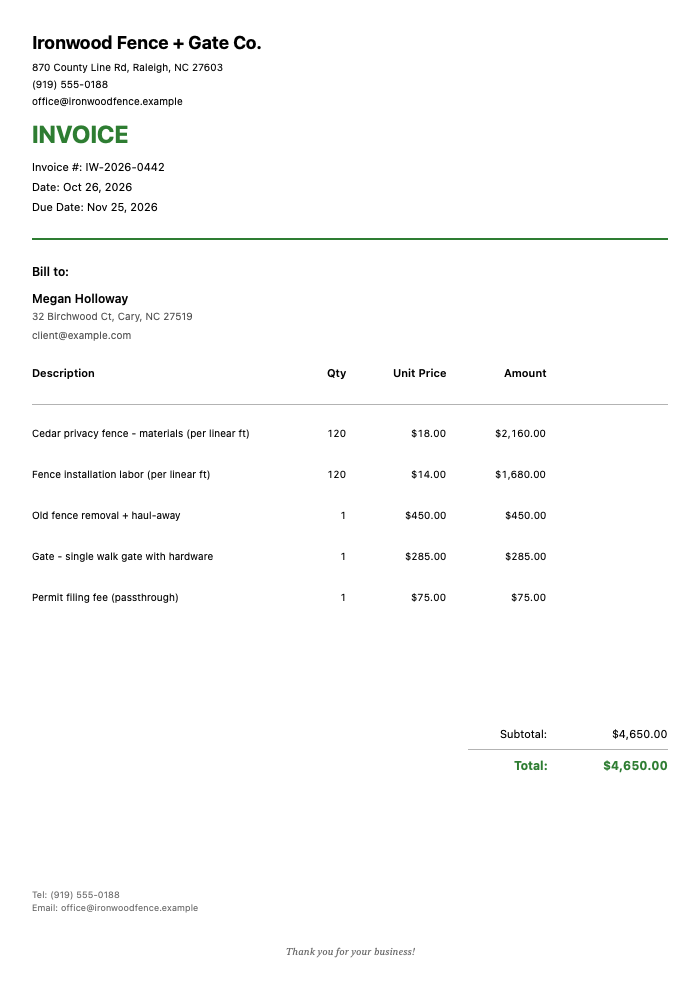
Here’s a fence contractor invoice for a 120-foot cedar privacy fence with a walk gate, old-fence removal, and a city permit:
Click to view full size
This invoice shows the structure fencing customers expect:
- Materials and labor each priced per linear foot — 120 feet at $18 materials and $14 labor — so the number ties directly to the footage quoted
- Old fence removal + haul-away as its own $450 line, separate from the install
- The walk gate with hardware itemized at $285, a distinct deliverable
- The city permit shown as a $75 passthrough, so the customer knows it went to the municipality — bringing the job to a $4,650.00 total
Because every line maps to something the customer discussed when they hired you, the invoice reads as the agreed job itemized — not a surprise.
Typical Fence Installation Rates
Fencing prices swing widely with material, height, terrain, and region. These are typical US ranges for installed fence (materials + labor combined) plus common add-ons — always price against your local material costs and labor market.
| Item | Typical Range | Unit |
|---|---|---|
| Wood privacy fence (installed) | $25 – $45 | Per linear ft |
| Chain-link fence (installed) | $15 – $30 | Per linear ft |
| Vinyl / PVC fence (installed) | $30 – $60 | Per linear ft |
| Aluminum / ornamental fence (installed) | $30 – $70 | Per linear ft |
| Old fence removal + haul-away | $3 – $8 | Per linear ft |
| Walk gate (with hardware) | $150 – $400 | Each |
| Double drive gate | $400 – $1,200 | Each |
| Post setting in concrete | $20 – $60 | Per post |
| Permit fee (passthrough) | $30 – $150 | Per job |
| Grading / difficult terrain surcharge | 10% – 30% | On labor |
Rates vary by material grade, fence height, soil and terrain, and region. Rocky or sloped ground raises labor. Always quote against current local material prices.
How Fence Contractors Bill
Most fencing pros use one of these approaches depending on job size:
Flat quote, pay on completion. For a straightforward residential fence, you quote one all-in number and collect it when the job’s done. Simple, and fine when the job is small enough that fronting materials isn’t a cash-flow risk.
Deposit + balance. The most common structure for mid-size jobs. Collect a deposit (often one-third) to cover materials before you start, then the balance on completion. Your invoice shows the deposit received and the remaining balance so the customer sees exactly what’s left.
Progress billing. For large or multi-phase jobs — commercial fencing, long runs, multiple gates — bill in stages: deposit, a draw at materials-delivered or midpoint, and the balance at completion. Each invoice references the one before so the running total stays clear.
Per-linear-foot with allowances. Some contractors quote strictly per foot plus named allowances for gates and removal. This works well when the exact footage isn’t final until layout, because the price scales cleanly with the measured run.
Whatever the structure, the invoice should always reconcile to the signed quote. The fastest way to a dispute is a final number the customer can’t trace back to what they agreed to.
Show Off Your Work: Before/After Photos
A finished fence transforms a yard — that sagging chain-link becoming a clean cedar privacy line is exactly the kind of result that wins your next job.
Before/after comparisons are your best marketing. They show potential customers precisely what you deliver. Use them in:
- Social media posts and reels
- Your website and portfolio
- Google Business Profile
- Follow-up messages to past customers
Pro tip: shoot the same angle before you start and after you finish. Use Before After Photo Compare to build a slider animation of the transformation — potential customers can drag to see the difference, and it gets far more engagement than a static side-by-side.
Getting the Balance Paid on Completion
The moment you finish a fence is the moment to collect. The customer is standing in their transformed backyard, happy with the result, and your professional invoice turns that goodwill into a paid balance before the mood cools.
That’s where building the invoice on-site helps. Apps like InvoiceZap let you produce a professional, itemized fencing invoice in about 30 seconds — set up a reusable template with your license number, warranty terms, and payment instructions, then drop in the footage, materials, labor, gate, and removal for each job.
Here’s how it works in practice with InvoiceZap: you keep a saved template with your business details and standard lines, record the customer’s deposit against the job when they pay it, and on completion add the remaining lines so the app shows the deposit already received and the balance due. You show the customer the final invoice on your phone, they pay the balance, and you mark it settled before you load the truck.
A few habits that get fencing balances paid faster:
- Collect a deposit before you buy materials and show it on the final invoice
- Reconcile the invoice to the signed quote line for line — no surprises
- Separate removal, gates, and permits so each cost is understood
- Show the balance due in bold — the customer should see exactly what’s left
- Produce the invoice on-site at completion, while the customer’s standing in the result
For related trade billing, see our handyman invoice template and landscaping invoice template. Before the job starts, a solid quote prevents disputes — see how to write professional estimates that win jobs and invoice vs estimate: when to use each. For a ready-made layout, see the contractor invoice templates collection.
Frequently Asked Questions
How do fence contractors price a job?
Most fencing is priced per linear foot, with materials and labor each calculated against the total footage, the fence material, and the height. Add-ons like gates, old-fence removal, and permits are priced separately. Showing materials per foot and labor per foot on the invoice keeps the total transparent and lets the customer reconcile it with your quote.
Should I take a deposit for a fence installation?
For most mid-size and large jobs, yes. You’re fronting potentially thousands of dollars in materials before installing anything, so a deposit — commonly one-third up front — protects your cash flow. Show the deposit received and the remaining balance clearly on the final invoice so the customer sees exactly what’s left to pay.
How do I bill for old fence removal?
Bill removal and haul-away as its own line, separate from the new installation, typically at $3–$8 per linear foot or a flat fee that covers labor and the dump charge. Customers often assume removal is included, so a clearly labeled line prevents the “I thought that was part of it” conversation.
Do I charge the customer for the permit?
Yes, when a permit is required, show it on the invoice as a passthrough at cost so the customer understands the money went to the municipality rather than to you. Being transparent that it’s a pass-through charge builds trust and keeps the permit from looking like an added markup.
What’s the fastest way to invoice a fence job on-site?
Use a reusable template on your phone that already holds your license number, warranty terms, and payment instructions, then add the footage, materials, labor, gate, and removal lines when the job’s done. An app like InvoiceZap builds the itemized invoice in about 30 seconds and can show a deposit already received against the balance, so you can collect on completion.
The Takeaway
A fence job is a few thousand dollars of materials and labor that the customer agreed to piece by piece — so the invoice should show it piece by piece. Price materials and labor per foot, line out removal, gates, and permits, and reflect any deposit already paid. An invoice that reconciles cleanly to the quote gets the balance paid on completion without a back-patio debate.
Ready to invoice your next fence job before you leave the yard? Try InvoiceZap free on your iPhone, iPad, or Mac. Build a professional, itemized fencing invoice in about 30 seconds, show the deposit and balance clearly, and collect on completion. Download InvoiceZap and start your 3-day trial.
Ready to Streamline Your Invoicing?
Create professional invoices in 30 seconds with InvoiceZap's mobile-first design. No sign-up required.
Try InvoiceZap FreeTags: