When “Cash and a Smile” Stops Working
You’ve run the same Saturday stall for two years. Card reader, a jar for cash, a little chalkboard with prices. It works. People wander up, grab a loaf or a jar of plum jam, tap or drop a fiver in the tin, and off they go.
Then the owner of the cafe two streets over stops by. She loves your sourdough. She wants four dozen loaves a week, delivered Thursday mornings, invoiced monthly so her bookkeeper can pay you on the shop’s normal cycle. She’s not going to stand at your table and tap a card for a standing order. She needs a proper invoice with your business name, an invoice number, terms, and a total her accountant can file.
That’s the moment a lot of market and fair vendors hit a wall. Retail stall sales are one thing. Selling to a business is a different animal, and it runs on paper (well, PDFs). Here’s when you actually need invoices, what belongs on a vendor invoice, and how to get them out fast without turning billing into a second job.
Stall Sales vs. When You Actually Need an Invoice
Let’s clear this up first, because it saves a lot of confusion.
Your regular retail stall sales, one shopper buying one jar with cash or a card tap, usually don’t need an individual invoice. A receipt is plenty, and your card reader or a simple sales log covers your records. You don’t invoice the person who buys a single tomato.
You need an invoice when you’re selling to a business or filling a large order. Specifically:
- Wholesale and standing orders. A cafe wants weekly bread. A grocer wants a case of your salsa every two weeks. A restaurant wants heirloom tomatoes through the summer. These buyers pay on terms, not on the spot, and they need documentation for their own books.
- Large custom or catering orders. Someone orders 100 jars of jam as wedding favors, or a market kitchen books you for a bulk prepared-food run. Big order, custom pricing, usually a deposit.
- Corporate gift orders. A local firm wants 12 gift boxes of your candles and preserves for clients. They’ll want an invoice with their company name on it to expense.
- Clean records for taxes and booth fees. Even when a buyer doesn’t demand an invoice, having one keeps your year-end tidy. Booth rent, market fees, wholesale income, and retail totals all need to reconcile when tax season shows up.
The pattern is simple. If a business is paying you, or the order is big enough that a handshake feels thin, you invoice.
What a Vendor Invoice Actually Needs
A vendor invoice isn’t complicated, but skip a field and you’ll get a “can you resend this with our PO number?” email that delays your money. Cover these:
- Your business name and contact info, plus your logo if you have one. This is your brand showing up in their inbox.
- A unique invoice number. One per invoice, in a sequence you can track. If you’re not sure how to set that up, our guide to invoice numbering systems that keep your books clean walks through it.
- The buyer’s business name and contact, and their PO number if they gave you one.
- Invoice date and due date. Not “net 30ish.” An actual date.
- Itemized lines with description, unit, quantity, unit price, and line total. For wholesale this is where case quantities live.
- Subtotal, sales tax (if it applies), and total due.
- Payment terms and how to pay you. Net-7, net-14, and whether that’s a bank transfer, a check to your farm’s address, or a payment app handle you list right on the invoice.
Sample: A Weekly Wholesale Delivery to a Cafe
Here’s what a standing order to that cafe might look like. Notice the units are cases and dozens, not single items, and the prices are wholesale, not what a shopper pays at the stall.
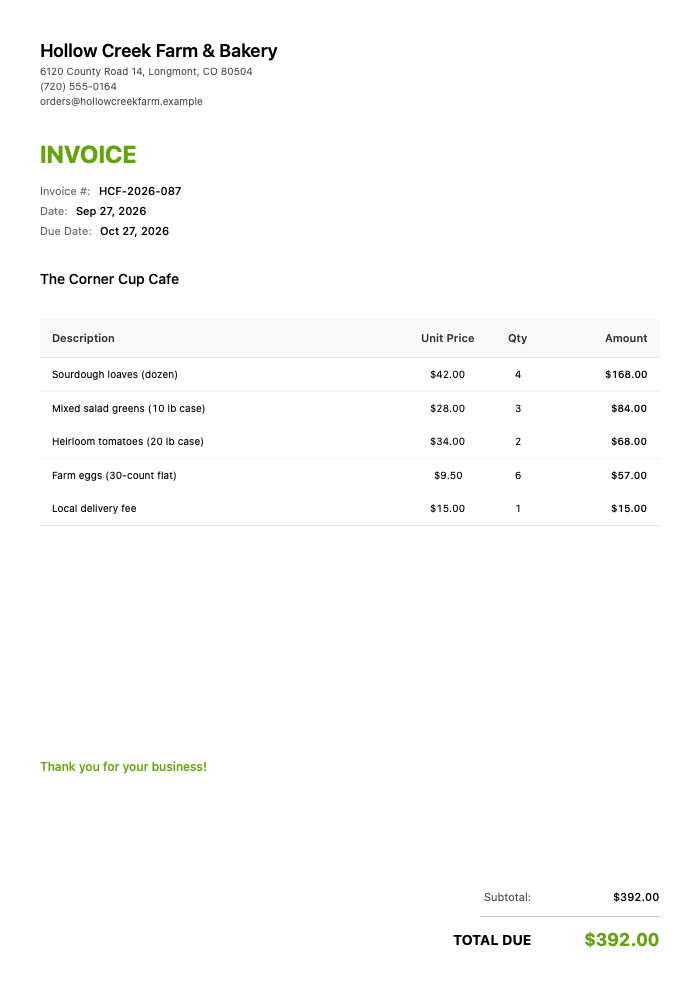
Click to view full size
Terms: Net-7. Payment by bank transfer or check. Same order repeats weekly.
That last line matters. A standing order is the same invoice, week after week, with maybe a small tweak to quantities. Hold that thought, because it changes how you should build these.
Wholesale vs. Retail Pricing (and Standing Orders)
The number one mistake first-time wholesalers make is charging their retail price to a business. Your $8 jar of jam at the stall might be $4.50 to $5.50 wholesale, because the cafe or shop needs room to mark it up and still make money. Wholesale is usually somewhere around half of retail, though it depends on your margins and volume.
A few things worth building into your pricing before you send that first wholesale invoice:
- Set a minimum order. Delivering three loaves isn’t worth the drive. A minimum (say $100) keeps small orders from eating your time, or add a surcharge for orders under the line.
- Charge for delivery. Your time and fuel to drop off in town is a real cost. List it as its own line.
- Decide your terms and stick to them. Net-7 for a weekly cafe order is common. Net-14 for a slower-paying grocer or restaurant is fine too. Longer terms mean you’re floating them a loan, so price accordingly. Our breakdown of payment terms that get you paid faster is worth a read before you commit to a cycle.
Standing orders are the sweet spot for a growing vendor. Predictable volume, predictable income. The billing for them should be equally predictable: the same clean invoice each cycle, with the invoice number bumped and the date updated. No reinventing the layout every Thursday morning.
Example Line Items Across Food and Craft Vendors
Whatever you sell, the structure is the same: describe it, pick a unit, price it, total it. Here’s a spread of realistic wholesale and bulk lines you can borrow from.
| Vendor | Line item | Unit | Example price |
|---|---|---|---|
| Produce | Heirloom tomatoes | case (20 lb) | $34.00 / case |
| Produce | Mixed salad greens | case (10 lb) | $28.00 / case |
| Bakery | Sourdough loaves | dozen | $42.00 / dozen |
| Bakery | Butter croissants | dozen | $30.00 / dozen |
| Preserves | Small-batch jam | case (12 x 8 oz) | $72.00 / case |
| Prepared food | Fresh salsa | case (12 jars) | $84.00 / case |
| Apiary | Raw honey | unit (16 oz) | $11.00 / jar |
| Crafts | Hand-poured candles | unit (wholesale) | $8.50 each |
| Logistics | Local delivery fee | flat | $15.00 |
| Policy | Minimum order surcharge (under $100) | flat | $10.00 |
| Custom | Wedding favor jam set (100 jars) | project | $650.00 |
| Corporate | Corporate gift set (12 boxes) | set | $360.00 |
Mix and match. A prepared-food vendor might invoice cases plus a delivery fee. A candle maker doing a corporate order lists the gift set as one project line with a deposit noted. The format flexes; the discipline stays the same.
Sales Tax and Resale Certificates (the Short, Non-Legal Version)
Two things trip up new wholesalers, and neither is as scary as it sounds. This is general information, not tax advice, so check your state’s rules or ask your accountant.
Sales tax on retail vs. wholesale. When you sell a jar to a shopper at your stall, you may owe sales tax on it depending on your state and what you sell (many states don’t tax unprepared food, for example). When you sell wholesale to a business that’s going to resell your product, that sale is usually tax-exempt, because the tax gets collected when the shop sells to the end customer. You don’t tax the middleman.
Resale certificates. To sell tax-free to a reseller, the buyer typically gives you a resale certificate (sometimes called a resale or seller’s permit number). Keep a copy on file. It’s their way of proving they’re buying to resell, and it’s your paper trail if the state ever asks why you didn’t collect tax on that cafe order. When tax applies, show it as its own line on the invoice so the total is crystal clear.
Keep every wholesale invoice, every retail sales total, and every resale certificate together. Come filing time you’ll thank yourself. Our tax season prep guide for organizing invoices has a simple system for keeping all of this straight through the year.
Getting Clean Invoices Out Fast
Here’s the practical problem. You’re at a market, hands covered in flour or dirt, and the wholesale buyer wants to lock in the order right there. Firing up a laptop and wrestling a spreadsheet template isn’t happening. This is where doing it from your phone changes everything, and where InvoiceZap fits the way vendors actually work.
Because the app is built mobile-first, you can put together a branded invoice in about 30 seconds standing at your stall: add the cafe as a buyer, drop in your case lines, set net-7 terms, and send the PDF before they’ve finished loading their van. Your logo and colors go on it automatically, so it looks like it came from a real business, not a note scribbled on a bag. If you want your invoices to look sharp from day one, our invoice branding and design guide covers the basics.
For those weekly standing orders, InvoiceZap lets you duplicate an existing invoice and adjust it in seconds rather than rebuilding it every cycle. That’s the honest way to handle a recurring cafe delivery: there’s no auto-billing running behind your back, you just copy last week’s invoice, bump the number and date, tweak quantities if they changed, and send. You stay in control of what goes out and when.
A few things worth knowing about how the app works, so you set the right expectations with buyers:
- It creates and sends professional invoices; it does not process the payment. Your buyer pays you by bank transfer, check, or whatever method you spell out on the invoice using the payment-instructions field.
- You track who’s paid manually, marking each invoice as paid when the money lands. Good for a vendor juggling a handful of wholesale accounts.
- Duplicating invoices makes standing orders quick, but nothing bills automatically. You send each one on purpose.
- There’s a 3-day full trial so you can run a real market weekend through it before deciding.
If you want to see how the itemized structure looks before you build your own, browse the invoice templates and use one as a starting point.
The Bottom Line
Your stall sales can stay cash-and-a-smile forever. But the minute a cafe, grocer, restaurant, or company starts buying from you, you’re running a small wholesale business, and wholesale runs on clean invoices with real terms. Get the fields right, price wholesale properly, set a minimum and a delivery fee, keep your resale certificates on file, and treat standing orders as a quick duplicate rather than a weekly chore.
Do that and the B2B side of your market business feels as easy as the retail side. Grab the InvoiceZap 3-day trial, build one wholesale invoice at your next market, and see how fast professional billing can be from the middle of a busy stall.
FAQ
Do I need to invoice my cash stall sales?
No. Individual retail sales to shoppers at your stall are fine with a receipt and a simple sales log. You invoice when a business buys from you or when an order is large or custom, like a wholesale account, a catering run, or a corporate gift order.
How is wholesale pricing different from my retail stall price?
Wholesale is the price you charge a business that’s going to resell your product, and it’s usually well below your retail price so the shop can mark it up and still profit. A jar that’s $8 at your stall might be around $4.50 to $5.50 wholesale. Set a minimum order and add a delivery fee to protect your margins.
What payment terms should I give cafes and stores?
Net-7 is common for a weekly cafe delivery, and net-14 works for grocers or restaurants that pay on a slower cycle. Put a specific due date on the invoice, not a vague “net 30ish,” and state exactly how they should pay you.
How do sales tax and resale certificates work for wholesale orders?
Wholesale sales to a business that resells your product are usually tax-exempt, with the tax collected when the shop sells to the final customer. The buyer typically gives you a resale certificate to document that, and you keep a copy on file. When tax does apply, show it as its own line. This is general info, so check your state’s rules or ask your accountant.
How do I handle a standing weekly order without rebuilding the invoice each time?
Duplicate last week’s invoice, update the invoice number and date, adjust any quantities that changed, and send it. Copying an existing invoice takes seconds. Nothing bills automatically, so you stay in control of every invoice that goes out.
Ready to Streamline Your Invoicing?
Create professional invoices in 30 seconds with InvoiceZap's mobile-first design. No sign-up required.
Try InvoiceZap FreeTags: