
Here’s the irony every bookkeeper knows: you spend your days making sure other people’s finances are clean, accurate, and on time — and your own invoicing is the thing that slips to the end of the month. You’ve got five monthly clients on retainer, one on hourly, a cleanup project that ballooned, and a new client you onboarded mid-month whose first invoice needs prorating. You of all people should have this dialed. And usually you do, once you stop rebuilding invoices from scratch every time.
This guide covers a bookkeeper invoice template that handles monthly retainers, hourly work, and cleanup projects, the rates bookkeepers actually charge, and how to bill clients cleanly so your own receivables look as tidy as the books you keep for them.
Why Bookkeeper Billing Has Its Own Quirks
You’d think the people best at numbers would have the easiest time invoicing. But bookkeeping has specific billing patterns that trip up even the organized.
Most of your revenue is recurring, which invites autopilot. Monthly retainer clients are the backbone of a bookkeeping practice — steady, predictable, wonderful for cash flow. And precisely because they’re the same amount every month, they’re easy to forget to bill, or to bill late, or to keep charging the old rate long after the client’s volume outgrew it. Recurring revenue only helps if the invoice actually goes out, on time, at the right price.
Scope creeps quietly in bookkeeping more than almost anywhere. The retainer was monthly reconciliation and reports. Then it was chasing down missing receipts, then answering the client’s ad-hoc “quick questions,” then a bit of payroll support, then untangling a mess before their tax accountant needed the file. Each addition felt minor. Together they’re hours you’re giving away if the invoice doesn’t show them.
Cleanup and catch-up jobs are wildly variable. A new client hands you eighteen months of unreconciled transactions and a shoebox energy. That’s not a retainer — it’s a project, often priced by the hour or as a scoped flat fee, and it needs its own invoice and its own expectations. Mixing it into the monthly retainer confuses everyone.
Your value is invisible when things go well. When the books are clean and nothing’s on fire, clients wonder what they’re paying for. A clear, itemized invoice that shows the reconciliations done, reports produced, and questions answered quietly reminds them every month.
You don’t need heavy software to bill your own clients well. You need an invoice that separates the retainer from the extras, handles cleanup as its own thing, and goes out reliably.
What Belongs on a Bookkeeper Invoice
A clean bookkeeping invoice answers what you did, what it cost, and how to pay — and reminds the client of your value. Include:
- Your practice name and contact (and business/tax number)
- Client business name and contact
- Invoice number and issue date
- Service period the invoice covers — essential for monthly work
- Itemized lines: retainer, reconciliations, reports, any out-of-scope work, each described clearly
- Subtotal, tax where it applies, and total due
- Payment terms (net 15, net 30, or auto-bill on the 1st)
- Payment instructions as plain text: bank transfer, ACH, card
- A brief summary note — “reconciled 3 accounts, delivered P&L and balance sheet, 142 transactions categorized”
That summary note is your quiet value statement. It costs you one line and it’s the difference between a client who renews without thinking and one who starts wondering whether they still need you.
Sample Line Items: Retainer + Out-of-Scope Month
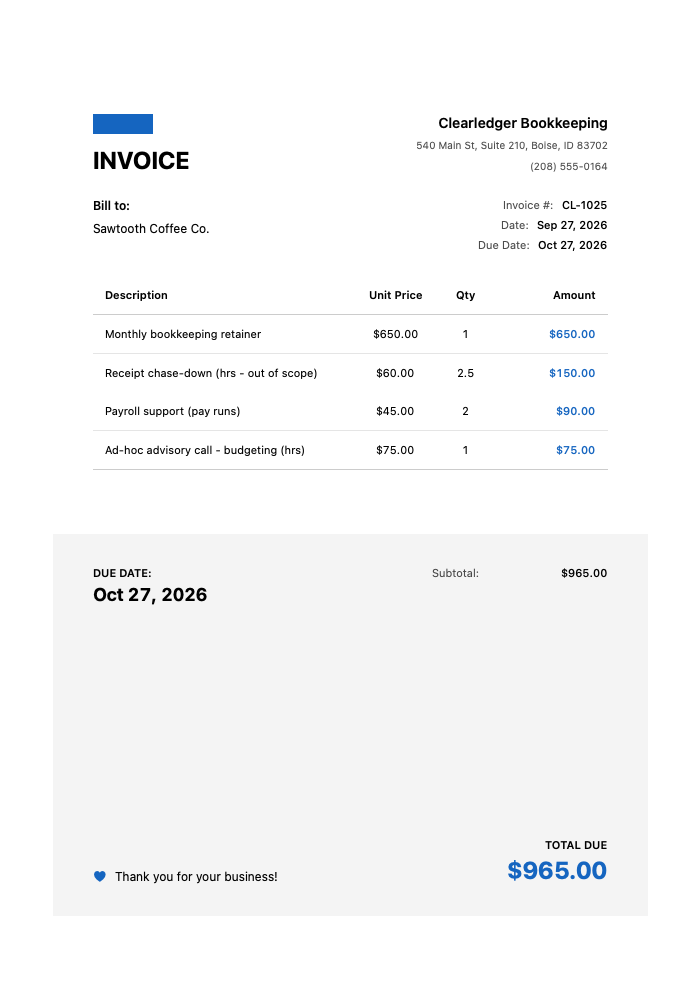
Here’s a clean invoice for a monthly retainer client who needed extra help one month:
Click to view full size
This invoice shows:
- The $650 monthly retainer covering reconciliation, categorization, and reports
- 2.5 hours of out-of-scope receipt chase-down at $60/hr ($150)
- Payroll support for 2 pay runs at $45 each ($90)
- A one-hour ad-hoc advisory call at $75, for a total of $965.00 (no tax — bookkeeping services often aren’t taxable, but check your state)
The retainer is the expected $650. Everything above it is tagged as out-of-scope work the client requested, each on its own line. The client sees exactly why this month cost more, and it opens the natural conversation about whether the retainer should grow.
Typical Bookkeeping Rates
Rates vary by region, client complexity, transaction volume, and your credentials. Treat these as a starting sketch.
| Service | Typical Rate | Unit |
|---|---|---|
| Hourly bookkeeping | $40–$90 | Per hour |
| Monthly retainer (micro business) | $250–$600 | Per month |
| Monthly retainer (small business) | $600–$1,500 | Per month |
| Monthly retainer (larger / complex) | $1,500–$4,000 | Per month |
| Cleanup / catch-up project | $50–$100 | Per hour |
| Payroll processing | $25–$75 | Per run |
| Financial reporting package | $150–$500 | Per month |
| Advisory / consulting call | $75–$200 | Per hour |
| Sales tax filing support | $75–$250 | Per filing |
| New client onboarding / setup | $300–$1,000 | One-time |
A note on retainers: review them at least twice a year. A client whose transaction volume doubled is now paying you the same rate for twice the work. The invoice is the reminder to have that conversation.
Three Ways to Bill Bookkeeping Work
Most practices use all three across their client base.
Monthly retainer. The client pays a fixed amount each month for a defined scope of ongoing work. This is the goal for most bookkeepers — predictable income, predictable relationship, easier planning for both sides. The discipline it requires is scope: write down what the retainer includes, define what counts as out-of-scope, and bill the extras separately so the retainer stays profitable as the client grows.
Hourly. You bill for time, best for new clients before you know their volume, variable-workload clients, or advisory work. Fair and flexible, but it caps your income at your hours and makes clients scrutinize your time on invisible work. If you go hourly, log time as you work and consider moving good clients to a retainer once their volume is predictable.
Project / flat fee. Cleanup jobs, catch-up work, and onboarding setups are scoped and quoted as their own thing, either flat or hourly with an estimate. Keep these on separate invoices from any ongoing retainer so the one-time nature is obvious and the client doesn’t expect it to recur.
Quick gut check: steady ongoing clients belong on retainers, new or variable ones start hourly, and cleanup work is always its own project. If you’re deciding how firm to be on due dates with small-business clients who run tight themselves, these payment terms are worth a read before you commit to net 30 across the board.
Making Your Own Invoicing Reliable
Here’s the friction: you’re keeping five or ten clients’ books immaculate, and your own invoicing is the task that gets done last, tired, at month-end — which is exactly when a retainer gets missed or an out-of-scope hour goes unbilled. The irony stings, but the fix is simple: make your invoicing take 30 seconds instead of twenty minutes.
This is where InvoiceZap fits. It’s built to send a professional invoice from your phone in about 30 seconds — so billing a client isn’t a chore you dread, it’s something you knock out between tasks. You save each client, pick a template, drop in the retainer and any extras, and your payment details ride along automatically. Worth being clear about what it is: InvoiceZap creates and sends the invoice document — it’s not accounting software and won’t replace the ledger you keep for clients. It’s the fast, clean way to bill your own clients for the bookkeeping you do. You mark invoices paid yourself as money lands, so your receivables stay as current as everything else you touch. There’s a 3-day full trial to see if it fits your month-end.
Billing promptly and consistently also models the behavior you probably nudge your own clients toward. If a client drifts past terms, keep a couple of follow-up email templates ready so the reminder is quick and professional. And if you want to compare the tools freelancers reach for, this rundown of invoicing software for freelancers is a good reference point; for a structured layout close to a bookkeeping practice’s needs, the accounting and bookkeeping invoice template is built for exactly this.
Wrapping Up
You keep other people’s finances clean; your own invoicing deserves the same standard. Separate the retainer from the extras, keep cleanup work on its own invoice, add a one-line summary that quietly proves your value, and get the invoice out on time every month. Set the template up once, match each client to the right billing model, and your receivables will finally look as good as the books you keep.
When you’re ready to make month-end billing a 30-second task, download InvoiceZap and send your next invoice in about 30 seconds. Start the 3-day trial, bill your retainer clients on the 1st, and stop being the last invoice out the door.
Frequently Asked Questions
Should bookkeepers charge monthly retainers or hourly?
Retainers are the goal for steady clients because they give both sides predictable income and planning. Hourly suits new clients before you know their volume and variable or advisory work. Many bookkeepers start a client hourly, learn their real workload, then move them onto a fixed monthly retainer once it’s predictable.
How much should a bookkeeper charge per month?
Monthly retainers commonly run $250 to $600 for micro businesses, $600 to $1,500 for typical small businesses, and more for complex or high-volume clients. The right number depends on transaction volume, number of accounts, and how much advisory work is included. Review retainers twice a year so a growing client isn’t underpaying you.
How do I bill for a cleanup or catch-up project?
Treat it as a separate project from any ongoing retainer, priced hourly or as a scoped flat fee with an estimate. Keep it on its own invoice so the one-time nature is clear and the client doesn’t expect it to recur. Cleanup work is variable, so give a range up front and update the client if the mess runs deeper than expected.
Can InvoiceZap do my clients’ bookkeeping?
No. InvoiceZap creates and sends professional invoices — it’s not accounting software and won’t keep a ledger or do reconciliations. It’s the fast way to bill your own clients for the bookkeeping services you provide, separate from whatever accounting platform you use to actually manage their books.
What’s the fastest way to invoice bookkeeping clients?
Save each client once, use a template, and send from your phone in about 30 seconds rather than rebuilding invoices at month-end. Automating your details and payment instructions means the retainer goes out on time every month and out-of-scope hours get captured while you remember them, keeping your own receivables current.
Ready to Streamline Your Invoicing?
Create professional invoices in 30 seconds with InvoiceZap's mobile-first design. No sign-up required.
Try InvoiceZap FreeTags: